New Feature: Multi Rater Feedback and 360 Appraisals

Industry guide · Φιλανθρωπικά ιδρύματα

Εμπιστευτική αναφορά για φιλανθρωπικούς οργανισμούς

Προστατευμένο κανάλι για εργαζόμενους και εθελοντές — διαχωρισμένο από γενικά inbox και δημόσιες φόρμες επικοινωνίας.

Οι φιλανθρωπικοί οργανισμοί χειρίζονται ευαίσθητες ανησυχίες για διακυβέρνηση, προστασία ευάλωτων και ακεραιότητα. Χρειάζονται κανάλι που να διατηρεί εμπιστευτικότητα και ίχνος ελέγχου χωρίς να συγχέεται με δημόσιες καταγγελίες.

Εθελοντές και προσωπικό σε κοινοτικό χώρο

Operational context

Common reporting concerns in charities

Charity speak-up often involves safeguarding practice, fundraising and grant integrity, volunteer culture, and trustee conduct—not only employee grievances. These are the kinds of concerns people raise when informal messages create no case record.

1

Safeguarding practice failures

Non-escalation of beneficiary welfare concerns, boundary breaches, and weak reporting culture that must reach the designated safeguarding lead—not informal local managers.

2

Misuse of funds & restricted income

Grant diversion, false claims, expense fraud, and fundraising impropriety first seen by finance or programme staff who fear repercussions in a mission-driven team.

3

Volunteer harassment & mistreatment

Bullying, discrimination, or retaliation affecting volunteers who sit outside HR systems and will not use personal email for follow-up.

4

Trustee conflicts of interest

Undeclared related-party contracting, board integrity concerns, and suppressed information that should not circulate through a CEO shared mailbox.

5

Beneficiary-adjacent staff conduct

Concerns involving service users that require tightly controlled handling and clear escalation to designated leads.

6

Governance & oversight failures

Policy overrides, failures of trustee oversight, and cultural barriers that leave serious themes invisible until a regulator disclosure.

How this can look in practice

Concrete charity situations where a case record beats informal messages—ownership depends on size, constitution, and whether a statutory safeguarding threshold is met.

Safeguarding practice gap

Volunteer coordinator reports that repeated welfare concerns about a beneficiary were not escalated per policy; requests anonymity from local managers.

Safeguarding
Restricted fund misuse

Finance officer flags grant spend outside donor conditions that programme leadership will not address.

Financial / fundraising integrity
Trustee conflict of interest

Senior staff raise undeclared related-party contracting involving a board member.

Governance

Process design

Reporting workflow for charities

A five-step internal route that supports charity governance—without replacing safeguarding procedures or Charity Commission prescribed-person escalation.

Step 1
Report submitted

Staff member, volunteer, or other authorised reporter uses the charity portal

Owner: Reporter

Step 2
Acknowledgement

Tracking reference issued; category and sensitivity assessed

Owner: Nominated intake lead

Step 3
Clarification

Two-way messaging gathers detail and evidence without personal email

Owner: Assigned handler

Step 4
Investigation

Findings documented with role-based access for safeguarding or finance leads

Owner: Case owner

Step 5
Resolution

Outcome logged for CEO, trustees, and any regulator-ready export

Owner: CEO / trustee lead

Misuse of company expenses — department head
DIS-IU3RWCKLFinancial MisconductSubmitted 19 Dec · 08:42
investigatingHIGHAnonymous
Report received
DIS-IU3RWCKL

Anonymous · portal submission

Assigned to
Operations lead

ops@...

Status
investigating

Case workspace open

Priority / risk
HIGH

AI triage complete

Next action
Clarify with reporter

Secure messaging thread

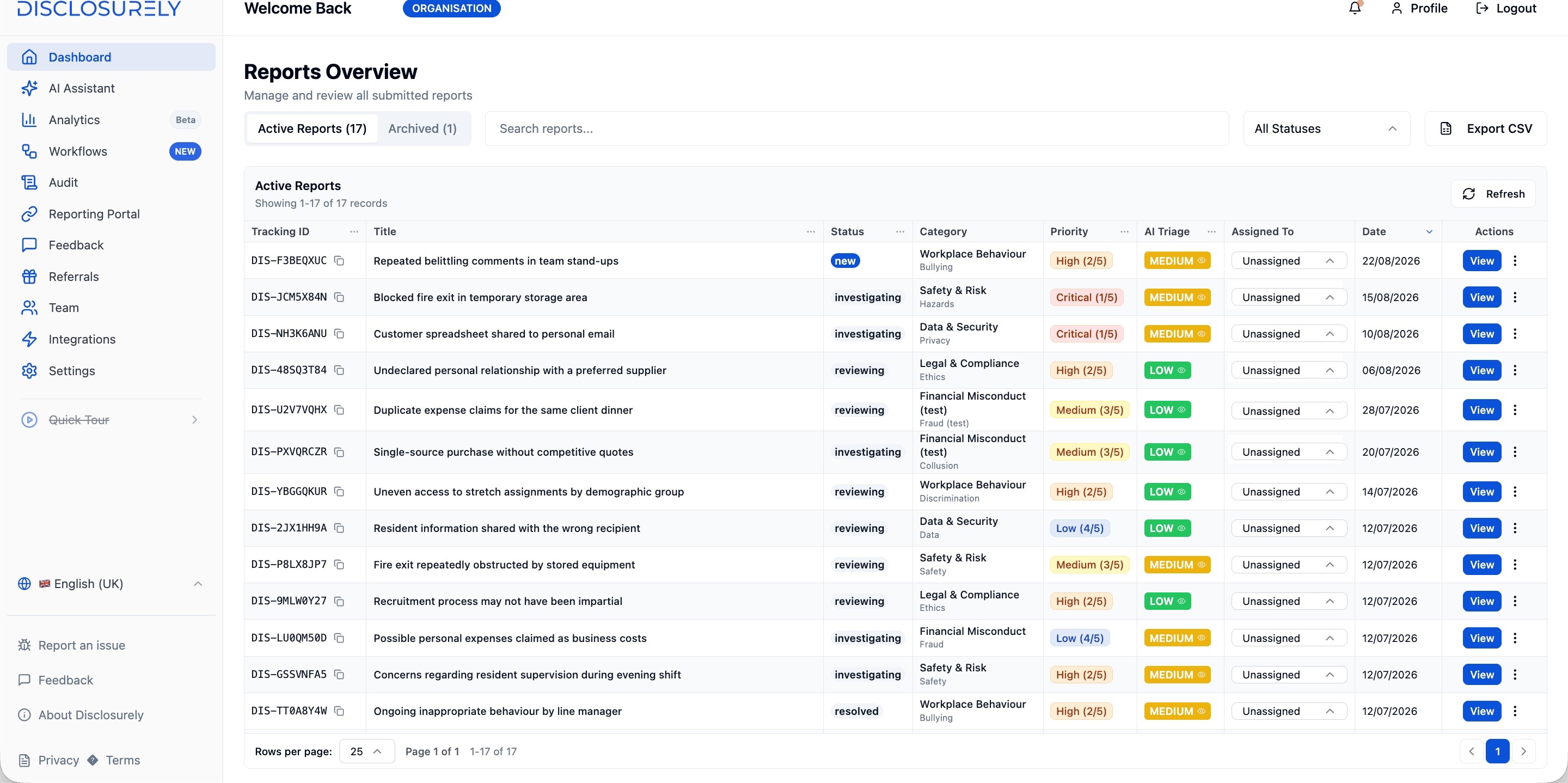
Case record replaces inbox threads — tracking ID, owner, status, and next action in one place.
Secure messagingEvidence linkedAudit trail
Ομάδα φιλανθρωπικού οργανισμού σε συνάντηση

Operating model

Who manages reports in a charity?

Ownership usually sits with a named safeguarding, compliance, or senior management lead, with trustee oversight for serious themes—routes vary by size and constitution.

How a report typically moves

Named ownership with a conflict bypass—not circulation through a shared CEO inbox

Staff / volunteer / contractor
Employees, volunteers, and delivery partners via branded portal
Safeguarding / compliance lead
Day-to-day triage and ownership for serious categories

If the usual handler is implicated, route the case elsewhere

Usual path
Initial review

Acknowledge, categorise, confirm handler can act

Conflict path
Alternate authorised reviewer

Another senior manager, nominated trustee, or independent intake

Handling / investigation

May involve the roles your charity actually has—not every organisation has all of these:

Safeguarding leadFinance / fundraising integrityCEO / senior managementNominated trustee
Trustees / board
Serious outcomes, recurring themes, and regulatory readiness
Common ownership models
Internal handling
Internal safeguarding / compliance route

Designated safeguarding lead or compliance owner

Escalation: CEO → nominated trustee / board committee

Split responsibility
Finance & fundraising integrity route

Finance lead or nominated officer

Escalation: CEO / treasurer → trustees

External adviser / independent support
Charity Commission prescribed-person route

Charity Commission (external) with parallel internal record

Escalation: Trustees retain visibility of internal handling and outcomes

Who normally handles what

Initial review

  • Acknowledge new cases and assign a category (safeguarding, finance, conduct, governance)
  • Confirm whether the nominated contact can handle the case or must step aside
  • Start secure follow-up with anonymous staff or volunteer reporters

Investigation

  • Gather evidence and keep the case chronology in one place
  • Route fundraising and financial-harm categories to finance leads as needed
  • Follow statutory safeguarding procedures where thresholds are met—software does not replace them

Escalation

  • Escalate trustee-implicated and board-sensitive cases to CEO or nominated trustees
  • Use the alternate owner when the usual handler is involved
  • Preserve evidence for Charity Commission or regulator-facing review where required

Oversight

  • CEO and trustees sponsor speak-up culture across employees and volunteers
  • Review serious outcomes and recurring themes
  • Resource investigations without retaliating against reporters

Common ownership models

Example models charities commonly use. Disclosurely does not dictate trustee duties or Charity Commission escalation—you map routes to your policy.

ModelEscalation
Internal safeguarding / compliance route
Designated safeguarding lead or compliance owner
CEO → nominated trustee / board committee
Finance & fundraising integrity route
Finance lead or nominated officer
CEO / treasurer → trustees
Charity Commission prescribed-person route
Charity Commission (external)
Charity keeps a separate record of any parallel internal handling

Product fit

Why Disclosurely for charities

Disclosurely structures internal speak-up for charities. It does not replace safeguarding procedures or Charity Commission referral routes.

Routes that include volunteers

A branded portal gives employees, volunteers, and contractors a visible channel without forcing them into personal email. Share the secure link and QR code in volunteer induction packs and office noticeboards so people can find the route when they need it.

Secure follow-up for sensitive cases

Handlers clarify details and collect evidence while preserving anonymity inside the case thread.

Governance-ready case history

Trustees and senior leaders can review ownership, status, and outcomes without reconstructing inboxes.

Next steps

Assess Disclosurely

Natural next steps for charity buyers evaluating commercial fit, security posture, and how reporting works for staff and volunteers.

Role-based access

Keep safeguarding and trustee-conduct cases limited to authorised owners.

Audit-ready chronology

Retain acknowledgements, messages, and outcomes for board or regulator conversations.

Practical deployment

Launch without rebuilding existing systems—important for smaller charities and lean teams.

FAQ

Charity buyer FAQs

Questions trustees, CEOs, and safeguarding leads typically ask.

Do small charities need whistleblowing software?

Many small charities still need a clear, confidential route for staff, volunteers and others to raise concerns. Software is not about size for its own sake—it is about ownership, secure follow-up, and a record trustees can review.

Can volunteers submit reports?

Yes. Charity reporting routes should cover the people who deliver the mission—employees, volunteers, contractors and, where appropriate, other stakeholders. You control portal access and category labelling.

Does this replace Charity Commission reporting?

No. Disclosurely supports your internal route. Qualifying disclosures may still need to go to the Charity Commission or another prescribed person under your policy and the law.

Who should own cases inside the charity?

Most charities nominate a safeguarding lead, compliance owner, or senior manager, with trustee escalation for serious matters. Exact roles should match your constitution and safeguarding framework.

What if a report concerns a trustee or the CEO?

Your ownership model should include an alternate route—another senior manager, nominated trustee, or independent intake—so the implicated person is not the default recipient. Disclosurely helps you assign cases away from conflicted handlers while keeping a single case record.

How does this sit alongside safeguarding procedures?

Organisational speak-up structures intake and case history; it does not replace statutory safeguarding thresholds or designated-lead duties. Map categories so safeguarding-adjacent disclosures reach the right owner quickly.

See how Disclosurely supports φιλανθρωπικά ιδρύματα reporting workflows.

Whistleblowing για φιλανθρωπικά ιδρύματα | Disclosurely