New Feature: Multi Rater Feedback and 360 Appraisals

Industry guide · Εκπαίδευση

Κανάλι αναφοράς για εκπαιδευτικούς οργανισμούς

Εμπιστευτική αναφορά για προσωπικό — διαχωρισμένη από συστήματα μαθητών και γενικές φόρμες παραπόνων.

Σχολεία, κολέγια και πανεπιστήμια χρειάζονται κανάλι για ανησυχίες προσωπικού και διακυβέρνησης με ελεγχόμενη πρόσβαση και τεκμηρίωση.

Εκπαιδευτικοί σε σύγχρονο πανεπιστημιακό διάδρομο

Operational context

Common reporting concerns in education

Speak-up in schools and trusts often sits between safeguarding practice, staff conduct, exam integrity, and trust-wide culture—not only as a formal child-protection referral.

1

Safeguarding practice failures

Staff may raise poor practice or ignored concerns about pupils through hallway conversations instead of a documented route that reaches the DSL or senior leadership.

2

Staff conduct allegations

Concerns about colleague conduct toward pupils need named ownership, limited visibility, and clear escalation to headteachers and, where thresholds are met, LADO—not shared inboxes or staffroom rumour.

3

Exam & academic integrity

Malpractice or pressure that undermines assessment standards still needs a protected disclosure route with investigation workflow—distinct from safeguarding referrals.

4

Financial & trust governance

Impropriety, conflicts, or procurement issues across a MAT or academy trust can be invisible if reporters only have a local line route.

5

Bullying & harassment among staff

Workplace conduct between colleagues sits beside—not instead of—pupil safeguarding duties, and still needs controlled case ownership.

6

Culture across a multi-academy trust

Workers may fear raising issues that reflect badly on their school, leaving patterns invisible to trustees and executive leaders without a trust-level speak-up route.

How this can look in practice

Concrete education situations where a case record beats informal channels—routes vary by school type, trust structure, and whether a statutory safeguarding threshold is met.

Safeguarding practice concern

Teaching assistant reports that repeated welfare concerns about a pupil were not escalated according to policy; requests anonymity from immediate colleagues.

Safeguarding practice
Allegation about staff conduct

Member of staff raises concern about inappropriate behaviour by a colleague toward pupils; case needs tightly controlled access and possible LADO consideration.

Staff allegation
Exam malpractice pressure

Exams officer flags direction to amend candidate work before submission.

Exam integrity
Concern about the headteacher

Staff member escalates ignored safeguarding practice to the chair of governors / trust route because the headteacher is implicated—documented alternate ownership away from local leadership.

Leadership conflict

Process design

Reporting workflow in education

A five-step internal route that supports KCSIE whistleblowing expectations—without mixing organisational speak-up into parent complaints, and without replacing DSL duties, LADO referral, or statutory safeguarding procedures.

Step 1
Report submitted

Staff or volunteer submits via the secure portal or documented whistleblowing procedure

Owner: Reporter

Step 2
Acknowledgement

Tracking reference issued; immediate child-protection risk assessed and statutory pathway engaged where required

Owner: DSL / senior leadership

Step 3
Clarification

Two-way messaging gathers detail and files without staffroom email threads

Owner: Assigned handler

Step 4
Investigation

Findings documented with limited access; LADO or external routes used where thresholds are met

Owner: DSL / HR / trust leadership

Step 5
Resolution

Outcome logged; themes available for governors, trustees, and audit

Owner: School / MAT governance

Misuse of company expenses — department head
DIS-IU3RWCKLFinancial MisconductSubmitted 19 Dec · 08:42
investigatingHIGHAnonymous
Report received
DIS-IU3RWCKL

Anonymous · portal submission

Assigned to
Operations lead

ops@...

Status
investigating

Case workspace open

Priority / risk
HIGH

AI triage complete

Next action
Clarify with reporter

Secure messaging thread

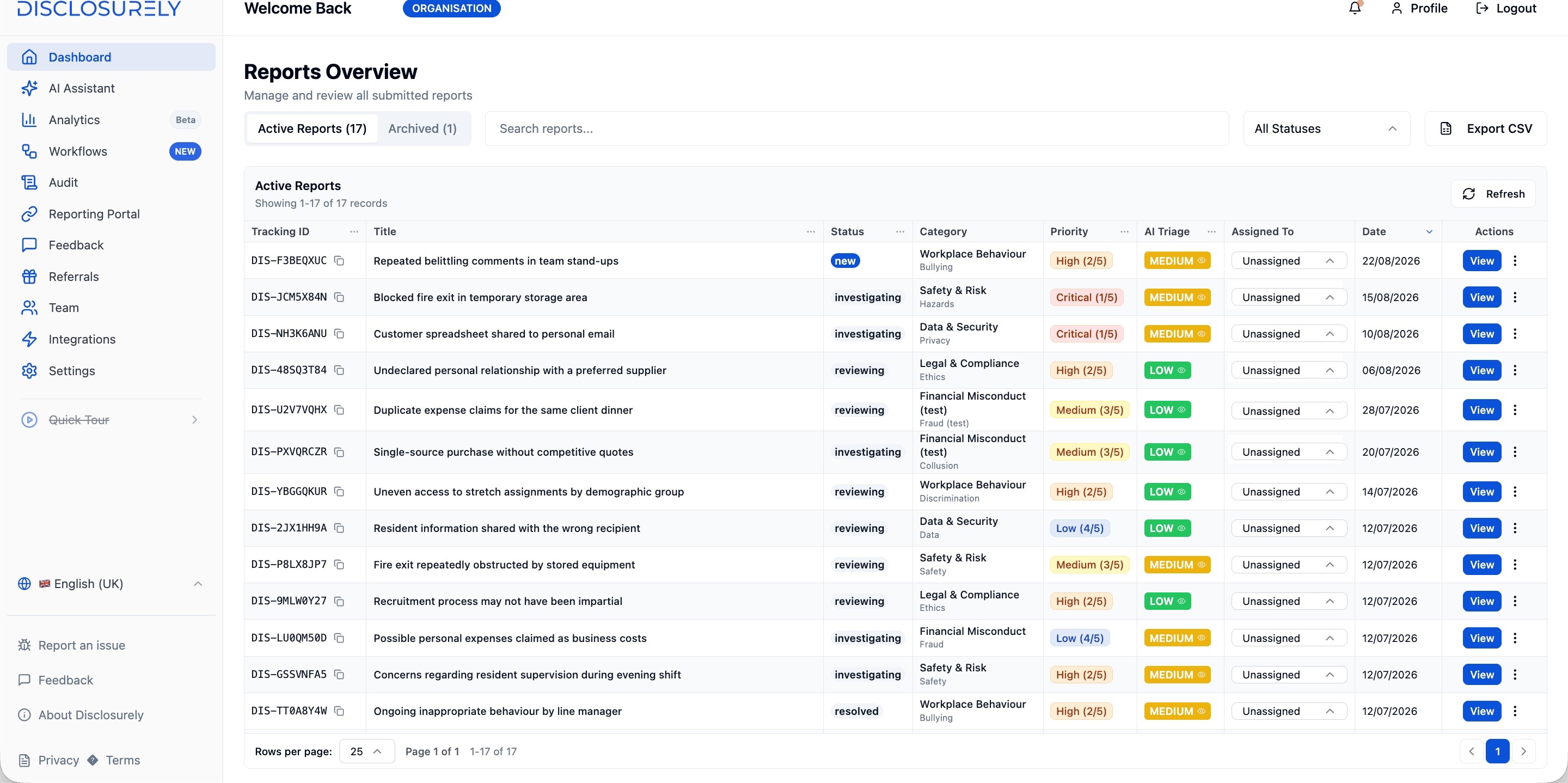
Case record replaces inbox threads — tracking ID, owner, status, and next action in one place.
Secure messagingEvidence linkedAudit trail
Συνάντηση προσωπικού σε εκπαιδευτικό ίδρυμα

Operating model

Who manages reports in education?

Speak-up routes should reach designated safeguarding and senior leadership quickly, with oversight across school, trust, and FE governance layers—and a clear alternate when local leadership is implicated.

How a report typically moves

Named ownership with a conflict bypass—alongside KCSIE duties, not instead of them

Staff / volunteer
Teachers, support staff, contractors, or volunteers via branded portal
DSL / nominated senior lead
Day-to-day intake and safeguarding triage under KCSIE whistleblowing procedures

If the normal owner is involved in the concern, route it elsewhere

Usual path
Initial review

Acknowledge, assess child-protection risk, confirm handler can act

Conflict path
Alternate authorised reviewer

Headteacher, trust lead, or other designated owner when local handler is implicated

Handling / investigation

May involve the roles your setting actually has—not every school has all of these:

DSL / safeguardingHR / school businessTrust complianceLADO pathway (threshold)
Governors / MAT trustees / FE governors
Serious outcomes, trust-wide themes, and governance oversight
Common ownership models
Internal handling
Internal KCSIE whistleblowing procedure

DSL or senior leadership designated in policy

Escalation: Headteacher / trust CEO → governors or trustees

Statutory pathway
Statutory safeguarding pathway

DSL; LADO and children’s services where thresholds met

Escalation: External child-protection agencies as required

External advice / independent support
External advice / prescribed routes

NSPCC Whistleblowing Advice Line or other external route

Escalation: School documents parallel internal handling separately

Who normally handles what

Initial review

  • Acknowledge new cases and assess immediate child-protection risk
  • Confirm whether the DSL or nominated contact can handle the case or must step aside
  • Start secure follow-up with anonymous reporters

Investigation

  • Gather evidence and keep the case chronology in one place
  • Route safeguarding practice to the DSL; conduct and employment matters to HR as needed
  • Ensure LADO and statutory procedures are followed—the platform does not replace them

Escalation

  • Escalate staff allegations and senior-implicated cases beyond local silence
  • Use trust-level or alternate owners when the usual school handler is involved
  • Keep governors, trustees, and external advisers working from the same case record

Oversight

  • Leadership and trustees sponsor speak-up culture across sites
  • Review serious outcomes and recurring themes without exposing case detail
  • Ensure retaliation is not tolerated at any level

Common ownership models

Example models—not a structure Disclosurely imposes. Education settings typically combine internal KCSIE whistleblowing procedures with statutory safeguarding routes and, where needed, external advice-line options.

ModelEscalation
Internal KCSIE whistleblowing procedure
DSL or senior leadership designated in policy
Headteacher / trust CEO → governors or trustees
Statutory safeguarding pathway
DSL; LADO and children’s services where thresholds met
External child-protection agencies as required
External advice / prescribed routes
NSPCC Whistleblowing Advice Line or other external route
School documents parallel internal handling separately

Product fit

Why Disclosurely for education

Disclosurely provides a structured internal route alongside KCSIE whistleblowing procedures. It does not replace DSL duties, LADO referral, children’s services thresholds, or statutory safeguarding procedures.

Clear internal channel for staff and volunteers

Gives workers a documented route when informal line channels feel unsafe—supporting KCSIE expectations for appropriate whistleblowing procedures, including volunteers and supply staff. Make reporting routes visible through induction materials, staff rooms and internal safeguarding communications, including a secure link and QR code where posters help.

Secure follow-up with case ownership

Tracking reference, assigned handler, two-way messaging, and status history—flexible enough for DSL-led, trust-led, or HR-supported models without pushing follow-up into school email.

Governor- and trustee-ready records

Present a school- or trust-branded portal and export themes for boards—without claiming to replace safeguarding leadership or multi-agency referral duties.

Next steps

Assess Disclosurely

Natural next steps for education buyers evaluating commercial fit, security posture, and how reporting works in practice.

Tight access for allegations

Limit staff-allegation and safeguarding-practice cases to the DSL, headteacher, and named investigators—never open staff directories.

Audit trail for governors and trustees

Retain acknowledgements, messages, and outcomes so leadership can evidence that concerns were received and owned.

Practical deployment across sites

Launch a school- or trust-branded portal without rebuilding MIS, safeguarding software, or parent complaint systems.

FAQ

Education buyer FAQs

Questions headteachers, DSLs, business managers, and trust leaders typically ask.

Does this replace the DSL or LADO process?

No. Disclosurely structures internal whistleblowing and speak-up intake. DSL decision-making, LADO referral, and statutory safeguarding procedures remain your legal and professional duties.

How does this sit with Keeping Children Safe in Education?

KCSIE expects appropriate whistleblowing procedures so staff can raise concerns with senior leadership. A structured portal and case record help you demonstrate that pathway—alongside, not instead of, your safeguarding policy. Staff-facing detail is in /blog/whistleblowing-in-schools.

Can volunteers and supply staff report?

Yes. Education settings often include volunteers, supply teachers, and contractors because they work with pupils but sit outside permanent-staff systems. You control portal access, categories, and who is notified. Statutory PIDA protection may not cover every volunteer—see /blog/whistleblowing-in-schools.

What about concerns that are not safeguarding referrals?

Exam integrity, financial impropriety, and staff culture issues still need a protected internal route. Categories and ownership help you triage those separately from immediate child-protection pathways.

What do the NSPCC helpline statistics mean for our school?

They describe contacts handled by the NSPCC Whistleblowing Helpline as a prescribed-person route—not the volume of reports inside school or trust speak-up programmes. Use them as sector context for why education-related concerns reach external advice lines, not as a measure of your internal programme size.

What if the concern is about the person who usually handles whistleblowing?

Your ownership model should include an alternate route—another senior leader, trust-level owner, or external advice-line path—so the implicated person is not the default recipient. Disclosurely helps you assign cases away from conflicted handlers while keeping a single case record. Practical headteacher/governor pathways are covered in /blog/whistleblowing-in-schools.

Is whistleblowing the same as a safeguarding referral or a grievance?

No. Safeguarding protects pupils; a grievance is usually personal to employment; whistleblowing is a worker raising public-interest wrongdoing. They can overlap—especially when staff raise ignored safeguarding practice. Read /blog/whistleblowing-in-schools, /blog/whistleblowing-in-early-years-and-childcare, and /blog/whistleblowing-vs-grievance.

See how Disclosurely supports εκπαίδευση reporting workflows.

Whistleblowing για εκπαίδευση | Disclosurely