Industry guide · SMEs
Reporting that scales when the inbox stops working
Structured disclosure routes for growing organisations—replacing shared inboxes and spreadsheets without enterprise procurement overhead.
Between roughly 50 and 500 people, informal reporting breaks down fast. Founders, office managers, and part-time HR leads cannot rely on hallway conversations and personal email when a concern involves a peer, a director, or someone who controls a contractor relationship. Growing SMEs need a named route, case ownership, and a record that survives turnover—without adopting an enterprise GRC platform.

Of occupational fraud cases in the ACFE global study were initially detected by a tip—the most common detection method.
Source: ACFE, Occupational Fraud 2026: A Report to the Nations · View source
Of those tips came from employees, reinforcing why growing organisations need an accessible internal reporting channel.
Source: ACFE, Occupational Fraud 2026: A Report to the Nations · View source
Median duration of occupational fraud schemes before detection—time that grows costly when reports stall in inboxes.
Source: ACFE, Occupational Fraud 2026: A Report to the Nations · View source
Operational context
Common reporting concerns in SMEs
Close-knit teams feel reporting risk acutely—everyone knows everyone. These are the kinds of concerns employees and contractors typically raise when informal routes stop being safe or reliable.
Fraud & financial misconduct
Expense abuse, payroll integrity issues, and supplier fraud—often first seen by finance or operations staff who hesitate to email a director.
Harassment & inappropriate behaviour
Bullying, discrimination, and interpersonal misconduct that is hard to raise when the person involved sits nearby or controls workload.
Conflicts of interest
Undeclared interests, preferential contracting, and policy overrides by senior people—especially sensitive in smaller leadership teams.
Misuse of company resources
Unauthorised use of assets, systems, or budget that may look minor until a pattern forms and no case record exists.
Health & safety
Workplace safety concerns and near misses that can be deprioritised against delivery pressure without a formal reporting route.
Management conduct & compliance
Concerns about how managers treat people, apply policy, or handle complaints—cases that should never sit only in a shared founder inbox.
How this can look in practice
Concrete SME situations where a case record beats an inbox—routes vary by your ownership model.
Finance administrator reports repeated approvals outside policy; fears career impact in a 40-person firm.
Buyer flags preferential contracting with a vendor owned by a senior manager’s associate.
Staff raise a recurring equipment fault dismissed in team meetings; no formal H&S log exists.
Process design
Reporting workflow for growing teams
Disclosurely replaces improvised inbox and spreadsheet handling with a controlled five-step process—light enough for a nominated lead, structured enough to defend when someone is on leave or escalations involve senior people.
Employee or contractor uses branded portal
Owner: Reporter
Tracking reference and category assigned within your SLA
Owner: HR or compliance lead
Two-way messaging gathers detail and files without email
Owner: Assigned handler
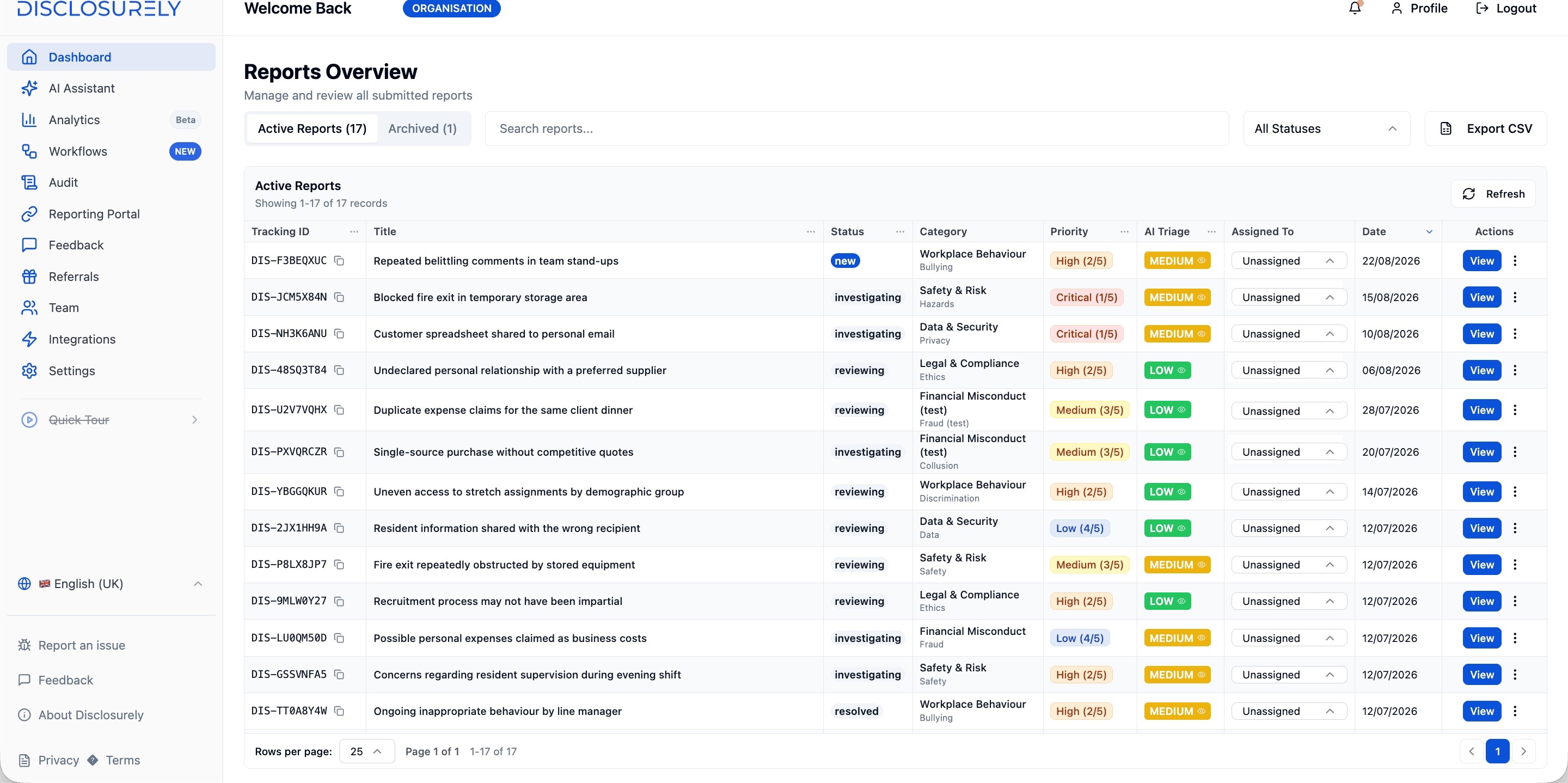
Notes, evidence, and status tracked in one case
Owner: Case owner
Outcome logged; themes available to MD or board
Owner: Managing director
Anonymous · portal submission
ops@...
Case workspace open
AI triage complete
Secure messaging thread

Operating model
Who manages reports in an SME?
Most growing organisations do not have a dedicated compliance department. Day-to-day ownership usually sits with a visible HR, operations, or finance lead, with a single executive escalation point—and an alternate route when the nominated contact is implicated.
Named ownership with a conflict bypass—not a fixed corporate hierarchy
If the normal owner is involved in the concern, route it elsewhere
Acknowledge, categorise, confirm handler can act
Bypass when the usual handler is implicated
May involve the roles your organisation actually has—not every SME has all of these:
HR manager or people lead
Escalation: Managing director or CEO
Operations or finance lead (common under ~100 people)
Escalation: Managing director or board
Third-party intake with documented handoff to internal owner
Escalation: Executive review with full audit export
Who normally handles what
Initial review
- Acknowledge new cases and assign a category
- Confirm whether the nominated contact can handle the case or must step aside
- Start secure follow-up with anonymous reporters
Investigation
- Gather evidence and keep the case chronology in one place
- Route fraud, conflicts, and financial concerns to finance/ops as needed
- Coordinate with accountants, insurers, or advisers when serious concerns arise
Escalation
- Escalate conflicts of interest and senior-implicated cases to leadership
- Use the alternate owner when the usual handler is involved
- Keep exporters and advisers working from the same case record
Oversight
- Leadership sponsors speak-up culture and resources investigations
- Review serious outcomes and recurring themes
- Ensure retaliation is not tolerated at any level
Common ownership models
Example models—not a governance structure Disclosurely imposes. Most SMEs pick one primary owner with clear executive escalation.
Product fit
Why Disclosurely for SMEs
SMEs often lack a dedicated ethics or compliance function. Disclosurely gives growing organisations structure without enterprise-scale administration—a case record from day one, without the procurement cycle or IT project that enterprise hotlines assume.
Low setup, fast adoption
Branded portal, categories, and case handling without rebuilding HR systems or hiring a GRC team first. Most growing teams configure handlers and go live without a long implementation project.
Case ownership that fits the team
Tracking reference, assigned handler, secure follow-up, and status history—flexible enough for an HR-led, ops-led, or adviser-supported model without imposing enterprise bureaucracy.
Evidence that survives staff turnover
Investigations span months; the case chronology stays with the company when someone leaves—ready for leadership review, insurer questions, or board follow-up.
Next steps
Assess Disclosurely
Natural next steps for SME buyers evaluating commercial fit, security posture, and how reporting works in practice.
Data access & roles
Limit sensitive cases to named handlers so peer networks cannot browse reports.
Retention thinking
Keep investigation history organised enough for insurers, auditors, or board questions later.
Exportable records
Take case chronologies and programme insight with you—without rebuilding history from email.
Guides & resources
Related guides for SME buyers
Practical pages that sit alongside this industry guide when you shape policy and vendor criteria.
FAQ
SME buyer FAQs
Questions growing organisations typically raise before replacing inbox intake.
Do small businesses need a whistleblowing system?
Not every SME needs enterprise software on day one—but close-knit teams often need a confidential route sooner than headcount suggests. Size matters less than whether informal email and hallway conversations still produce a defensible case record when a concern involves a founder, manager, or someone who cannot sit in a shared inbox.
Who should receive reports in a small organisation?
Most SMEs nominate one visible contact—often HR, operations, office management, or finance—with a clear executive escalation path. What matters is naming ownership in advance, including an alternate when the usual handler is implicated.
Can employees report anonymously?
Yes. Disclosurely supports anonymous intake with secure two-way follow-up so identity is not exposed through email metadata, display names, or shared mailboxes—especially important in close-knit teams.
What happens if the report concerns the person who normally handles complaints?
Your ownership model should include an alternate route—another internal owner, senior leader, or external adviser-supported intake—so the implicated person is not the default recipient. Disclosurely helps you assign cases away from conflicted handlers while keeping a single case record.
Is Disclosurely suitable without a dedicated compliance team?
Yes. Many SMEs start with a nominated ownership model—an operations lead, office manager, or finance lead—while keeping a real case record. The platform is designed to provide structure without requiring an enterprise ethics or GRC function.
How quickly can an SME go live?
Most growing teams configure branding, categories, and handlers without a long implementation project. A walkthrough or trial is the fastest way to confirm the workflow fits your ownership model.
See how Disclosurely supports smes reporting workflows.