Book a 10-minute walkthrough for your reporting process →

Industry guide · Healthcare

Speaking-up routes built for healthcare providers

Structured disclosure routes for staff concerns—distinct from clinical records, patient safety systems, and Freedom to Speak Up roles.

Trusts, ICBs, primary care, and independent providers operate under national Freedom to Speak Up expectations, CQC well-led scrutiny, and Clinical Governance oversight. Workers need routes that feel independent of line management; governance teams need structured intake, limited access, and evidence that concerns were triaged and owned—not lost in a shared inbox or clinical incident log.

Healthcare staff collaborating in a modern NHS-style clinical corridor
433

Whistleblowing disclosures received by NHS England as a prescribed person in 2023/24 (England remits: primary care, NHS trusts/foundation trusts, ICBs, and related workforce education functions).

Source: NHS England prescribed person whistleblowing report, 2023/24 · View source

257

In-scope disclosures (59% of those received) falling within NHS England’s prescribed-person remit in 2023/24.

Source: NHS England prescribed person whistleblowing report, 2023/24 · View source

1,000+

Freedom to Speak Up Guardians supporting workers across NHS and related organisations in England (network scale reported by the National Guardian’s Office).

Source: National Guardian’s Office, 2022/23 annual data report · View source

Operational context

Common reporting concerns in healthcare

Speaking-up matters often sit between workplace conduct, Patient Safety culture, and governance—not always as a formal clinical incident. These are the kinds of concerns clinical and operational staff typically raise when line management or shared inboxes are not a safe route.

1

Conduct & bullying on shift

Intimidation, exclusion from rotas, harassment, and discriminatory behaviour between staff—especially hard to raise across rotating shifts and hierarchical teams.

2

Patient Safety culture concerns

Organisational factors affecting safety speak-up—ignored thresholds, recurring near-miss gaps, or environment-of-care issues that never reach clinical incident systems.

3

Safeguarding-adjacent staff conduct

Concerns touching vulnerable adults, staff behaviour in care settings, or weak escalation culture that must reach Safeguarding Leads—not informal ward handling.

4

Procurement & governance integrity

Supplier favouritism, undeclared conflicts, expense misuse, and policy breaches first seen by finance or corporate staff who fear departmental pushback.

5

Record & training integrity

Falsified mandatory training completions, signed-off records without attendance, or documentation practices that undermine CQC and Clinical Governance assurance.

6

Bank, locum & multi-site access concerns

Non-permanent workers raise sensitive disclosures without a visible authorised route across trust, primary care, and independent sites.

How this can look in practice

Concrete healthcare situations where a structured case record beats an inbox—routes vary by trust, ICB, and independent provider model.

Bullying within a clinical team

Ward staff report repeated intimidation; reporter requests anonymity and FTSU support across rotating shifts.

Conduct & culture
Falsified mandatory training records

Non-clinical staff allege completion records were signed off without attendance.

Governance & compliance
Procurement irregularity

Finance employee flags a supplier relationship with a department head.

Fraud & governance

Process design

Reporting workflow in healthcare settings

A five-step organisational route connecting intake, clarification, investigation, and closure—without mixing speaking-up into Datix, ePRR, or other patient safety incident systems, and without replacing Freedom to Speak Up Guardians.

Step 1
Report submitted

Worker raises a concern via the secure portal or documented FTSU / speaking-up route.

Owner: Anonymous or identified reporter

→
Step 2
Acknowledgement

Tracking reference issued; category and urgency assessed against People, FTSU, or safeguarding ownership.

Owner: People / FTSU intake

→
Step 3
Clarification

Protected two-way messages gather context and evidence without shared clinical or departmental inboxes.

Owner: Assigned case handler or FTSU Guardian

→
Step 4
Investigation

Findings documented with role-based access; clinical incident systems remain separate where they apply.

Owner: People, governance, or clinical lead

→
Step 5
Resolution

Outcome recorded for audit, board, and CQC-ready evidence; themes feed speaking-up reports.

Owner: Case owner / Clinical Governance

Bullying within a clinical team
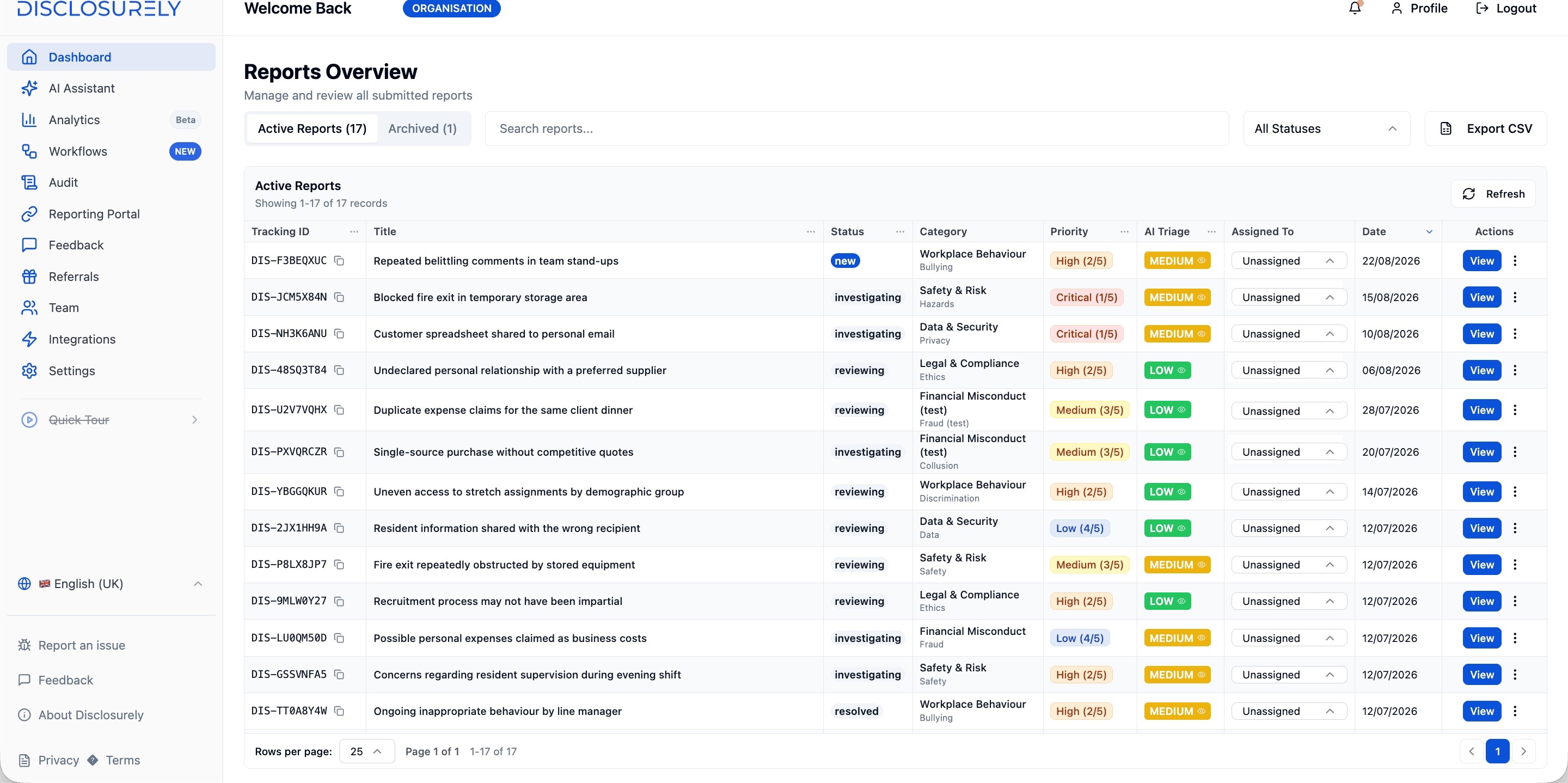
HC-2841Conduct & culture2 days ago
Under investigationHighAnonymous
Submitted
Anonymous

Ward staff via branded speaking-up portal

Acknowledged
Same day

People / FTSU intake assigned tracking reference

Clarification
Secure thread

Shift pattern and witnesses gathered without email

Investigation
In progress

People lead with FTSU Guardian support

Resolution
Pending

Outcome for workforce committee evidence

Speaking-up case remains separate from Datix / clinical incident systems.
People & ODFTSU GuardianSecure follow-up
Healthcare colleagues reviewing care pathways in a bright clinical workspace

Operating model

Who manages reports in healthcare?

Speaking-up routes should bypass accidental gatekeeping while keeping escalation clear for Clinical Governance, safeguarding, and board oversight. Day-to-day ownership usually combines People services with Freedom to Speak Up independence.

How a report typically moves

Named ownership with a conflict bypass—alongside Freedom to Speak Up independence

Staff / contractor
Clinical, operational, bank, locum, or corporate workers via branded portal
People / FTSU intake
Day-to-day acknowledgement, categorisation, and initial ownership

If the usual handler is implicated, route the case elsewhere

Usual path
Initial review

Acknowledge, categorise, confirm handler can act

Conflict path
Alternate authorised reviewer

FTSU Guardian, another People lead, or nominated executive bypass

Handling / investigation

May involve the roles your provider actually has—not every organisation has all of these:

People & ODFreedom to Speak Up GuardianClinical GovernanceSafeguarding Lead
Executive & board
Serious outcomes, recurring themes, and CQC / NHS England notification where required
Common ownership models
Internal handling
Internal People & OD route

People director / HR business partner

Escalation: Executive director (people) → board workforce committee

Split responsibility
Freedom to Speak Up Guardian

FTSU Guardian (independent of line management)

Escalation: Trust board → NHS England external FTSU where applicable

External adviser / independent support
External / third-party intake

Compliance lead or outsourced intake provider

Escalation: Audit & risk committee; CQC or regulator referral where required

Who normally handles what

Initial review

  • Acknowledge new cases and assign a category (People, FTSU, or safeguarding)
  • Confirm whether the nominated contact can handle the case or must step aside
  • Start secure follow-up with anonymous reporters

Investigation

  • Gather evidence and keep the case chronology in one place
  • Route Patient Safety culture and clinical-conduct themes to Clinical Governance as needed
  • Involve Safeguarding Leads when disclosures are safeguarding-adjacent

Escalation

  • Escalate senior-implicated or board-sensitive cases to executive sponsors
  • Use the alternate owner when the usual handler is involved
  • Keep NHS England external FTSU and regulator-facing exports working from the same record

Oversight

  • Executive sponsors champion speaking-up culture and resource investigations
  • Review serious outcomes and recurring themes for board and CQC well-led conversations
  • Ensure detriment is not tolerated at any level

Common ownership models

Most providers combine internal People routes with Freedom to Speak Up independence; NHS England also acts as a prescribed person for external disclosures within its remits.

ModelEscalation
Internal People & OD route
People director / HR business partner
Executive director (people) → board workforce committee
Freedom to Speak Up Guardian
FTSU Guardian (independent of line management)
Trust board → NHS England external FTSU where applicable
External / third-party intake
Compliance lead or outsourced intake provider
Audit & risk committee; CQC or regulator referral where required

Product fit

Why Disclosurely for healthcare

Disclosurely does not replace Freedom to Speak Up Guardians, Clinical Governance, Safeguarding Leads, or systems such as Datix—it structures intake, follow-up, and case history alongside the routes and policies you already operate.

Separate from clinical and incident systems

Organisational speaking-up stays out of Datix, ePRR, and patient records while reaching the right case owner—People, FTSU, or Safeguarding.

Secure anonymous follow-up

Reporters and case handlers can clarify details through protected messaging without routing sensitive threads through shared inboxes or line management.

Traceable governance evidence

Role-based access, categorisation, and a full case trail give Clinical Governance and compliance teams defensible records for board and CQC conversations.

Next steps

Assess Disclosurely

Natural next steps for healthcare buyers evaluating commercial fit, security posture, and how speaking-up works alongside FTSU and Clinical Governance.

Role-based access for sensitive cases

Limit People, FTSU, and safeguarding cases to authorised handlers so ward or departmental teams cannot browse disclosures.

Audit-ready chronology

Retain acknowledgements, messages, evidence notes, and outcomes for board workforce committees and CQC well-led conversations.

Exportable programme records

Take case chronologies and theme insight with you for speaking-up reports—without reconstructing history from email.

FAQ

Healthcare buyer FAQs

Questions People, Freedom to Speak Up, and Clinical Governance leads typically raise before shortlisting a platform.

Does Disclosurely replace Freedom to Speak Up Guardians?

No. Guardians remain an independent, impartial route under national FTSU expectations. Disclosurely can structure organisational intake, secure follow-up, and case history alongside Guardian support—it does not perform the Guardian role.

Will speaking-up cases mix with Datix or other incident systems?

They should not. Organisational speaking-up stays separate from patient safety incident logging. Clinical incidents continue through your existing incident systems; Disclosurely is for staff concern routes and governance ownership.

How does this relate to NHS England as a prescribed person?

NHS England receives external whistleblowing disclosures within defined England remits. Providers still need credible internal routes so workers do not only escalate externally. Disclosurely supports internal handling records—it is not an NHS England channel.

Can bank, locum, and primary care staff use the same portal?

Yes. Many providers need a visible route for non-permanent and multi-employer workers. You control portal access, categories, and which People, FTSU, or safeguarding owners receive notifications.

Who should receive reports day to day?

Most providers nominate People & OD intake alongside Freedom to Speak Up Guardians, with Safeguarding Leads and Clinical Governance for relevant categories. What matters is naming ownership in advance—including an alternate when the usual handler is implicated.

How does this support CQC well-led conversations?

A clear case chronology—acknowledgements, ownership, messages, and outcomes—gives evidence that concerns were taken seriously and owned, which supports speaking-up culture discussions without reconstructing history from email.

See how Disclosurely supports healthcare reporting workflows.

Confidential Reporting for Healthcare Organisations | Disclosurely