Industry guide · Housing Associations
Staff speak-up routes for social housing providers
Structured disclosure routes for housing association staff—distinct from resident complaints, and aligned with regulator expectations.

The Regulator of Social Housing (RSH) has been a prescribed person under PIDA for registered providers since 2019. In 2024–25 the RSH processed and concluded 36 qualifying disclosures (1 April 2024 to 31 March 2025); 33 were referred for more detailed consideration and 21 were investigated. Staff whistleblowing is not a resident complaints journey, and it is not a Housing Ombudsman process—the Ombudsman is clear that staff whistleblowing sits with the RSH. Providers need a defensible internal staff channel that is not the same system as tenant complaints.

Qualifying disclosures processed and concluded by the Regulator of Social Housing (1 Apr 2024–31 Mar 2025).
Source: RSH whistleblowing report 2024-25 · View source
Of those disclosures referred for more detailed consideration.
Source: RSH whistleblowing report 2024-25 · View source
Disclosures investigated by the RSH in 2024–25.
Source: RSH whistleblowing report 2024-25 · View source
Operational context
Common staff reporting concerns in housing associations
These are staff and contractor disclosures about organisational wrongdoing—not tenancy complaints, neighbour disputes, or Housing Ombudsman matters. Keep those on your resident complaints pathway.
Contractor & procurement misconduct
Kickbacks, inflated invoices, or preferred-supplier arrangements in repairs and development—often first seen by procurement or estate-facing staff who will not email the implicated manager.
Staff conduct & workplace culture
Bullying, harassment, or retaliatory behaviour inside the provider workforce—cases that belong in a protected staff route, not a resident service complaint.
Safeguarding practice failures
Staff concerns that safeguarding procedures are being bypassed or that vulnerable residents are at risk because organisational practice is failing—raised by colleagues, not as a standard tenancy complaint.
Governance & consumer-standard disclosures
Employees escalating board, executive, or consumer-standard failings (for example suppressed safety or service-risk information)—as internal protected disclosures, not Housing Ombudsman cases.
Conflicts of interest
Undeclared interests in contractors, land deals, or appointments—especially sensitive where the usual governance contact sits close to the people involved.
Financial misconduct
Expense abuse, misuse of funds, or false billing that staff see before audit or finance leadership—requiring a case record outside the shared inbox.
How this can look in practice
Concrete staff-disclosure scenarios—ownership varies by provider size and group structure. These are not resident complaints or Ombudsman journeys.
Procurement officer flags invoices for void-property works that were not completed; fears career impact if the neighbourhood manager is informed first.
Repairs supervisor reports instructions to close jobs without addressing known fire-safety defects—an internal disclosure about organisational practice, not a tenant complaint form.
Senior leader raises concern that material risk information is being withheld from the audit committee.
Process design
Reporting workflow for registered providers
A five-step internal speak-up route for staff and contractors—kept separate from resident complaints, and designed to produce records that support governance and any RSH engagement.
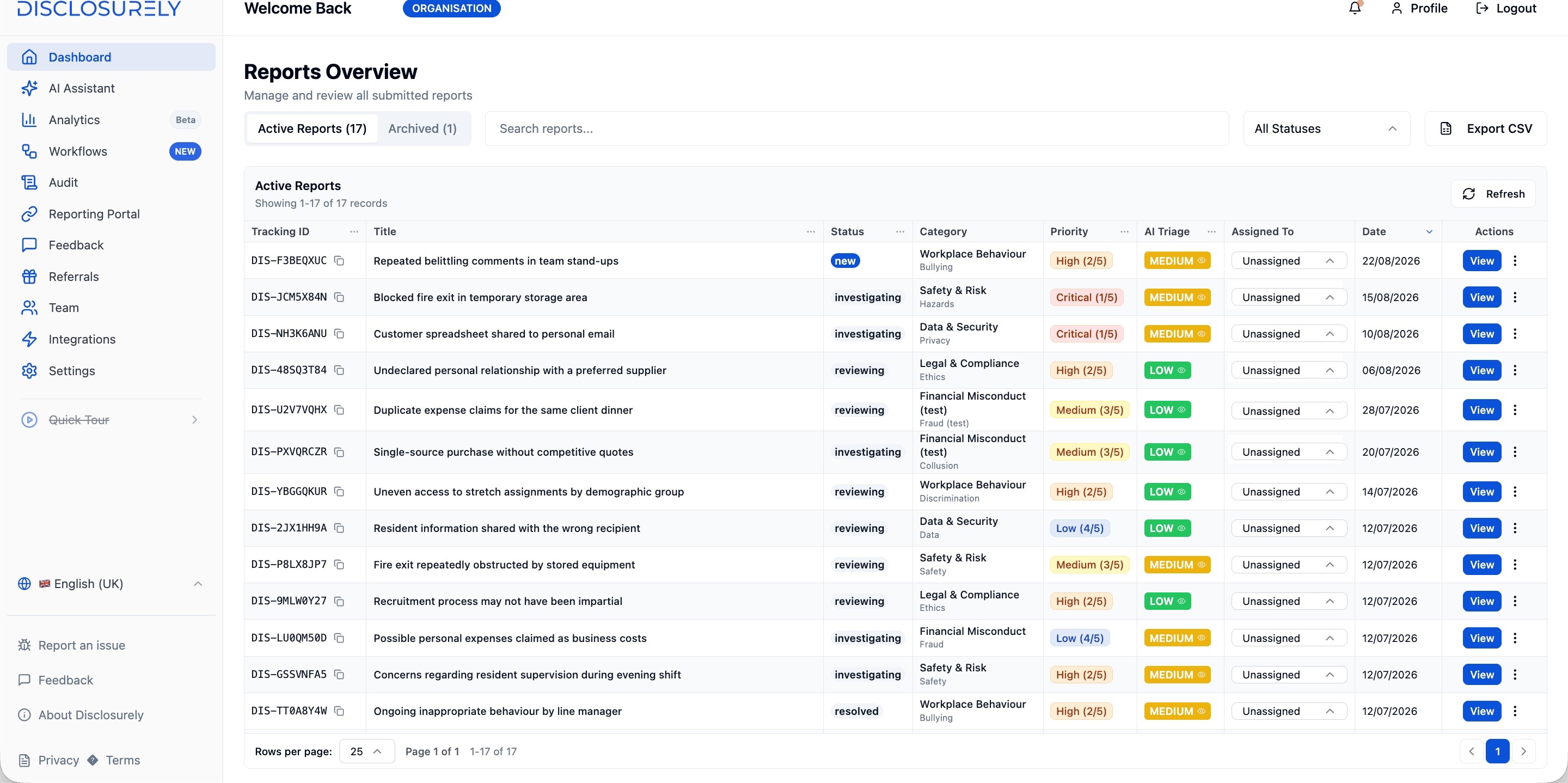
Worker or contractor submits via secure staff portal—not the resident complaints channel
Owner: Reporter
Tracking reference issued; confirm staff whistleblowing vs resident complaint and hand off if misrouted
Owner: Company secretary / governance
Two-way messaging gathers detail and evidence without open email
Owner: Assigned handler
Findings documented with role-based access and an audit trail
Owner: Risk, audit, or commissioned investigator
Outcome logged for board; consider prescribed-person escalation where required
Owner: Audit committee / company secretariat
Anonymous · portal submission
ops@...
Case workspace open
AI triage complete
Secure messaging thread

Operating model
Who manages staff reports in a housing association?
Speak-up ownership usually sits with the company secretary and governance or risk functions, with executive directors and the audit committee providing oversight—and a clear external RSH route for qualifying disclosures. Resident complaints remain a separate path.
Named ownership with a conflict bypass—kept separate from resident complaints
If the usual governance owner is involved in the concern, route it elsewhere
Acknowledge, categorise, confirm handler can act
Bypass when the company secretary or nominated lead is implicated
May involve the functions your provider actually has:
Company secretary or governance / risk lead
Escalation: Executive directors → audit committee
Regulator of Social Housing (external)
Escalation: Provider keeps a parallel internal case record where work continues
Complaints / customer service
Escalation: Must not absorb staff protected disclosures
Who normally handles what
Initial review
- Acknowledge new cases and confirm staff whistleblowing vs resident complaint routing
- Assign category and confirm the company secretary / governance handler can act
- Start secure follow-up with anonymous reporters
Investigation
- Gather evidence and keep the case chronology in one place
- Route procurement, safeguarding practice, and financial concerns to the right specialists
- Coordinate with audit or external investigators when serious concerns arise
Escalation
- Escalate senior-implicated and consumer-standard themes to executive directors
- Use an alternate authorised reviewer when the usual handler is involved
- Advise when external RSH referral may be appropriate under policy
Oversight
- Audit committee and board review serious outcomes and recurring themes
- Challenge management where cases stall or are diluted
- Use exports for assurance without reconstructing history from email
Common ownership models
Registered providers typically run an internal staff speak-up route alongside the RSH prescribed-person channel—while keeping resident complaints and Housing Ombudsman matters on a separate track.
Product fit
Why Disclosurely for housing associations
Registered providers need a staff speak-up channel that is visibly separate from tenant complaints. Disclosurely structures that internal route—it does not replace RSH referral, resident complaint processes, or Housing Ombudsman pathways.

Staff portal distinct from resident complaints
Anonymous reporting and secure messaging give employees and contractors a channel that is not the same system tenants use for service complaints or Ombudsman journeys. QR posters and shared staff-office access points help depot and office teams find the staff channel—without confusing it with resident notices.
Case ownership for CoSec and governance
Tracking reference, assigned handler, secure clarification, and status history—fit for company secretariat, executive directors, and audit committee escalation.
Board- and RSH-ready chronology
Acknowledgement, messaging, evidence, and outcomes stay in one place for audit committee assurance and any parallel regulatory conversations.
Next steps
Assess Disclosurely
Natural next steps for registered-provider buyers evaluating commercial fit, security posture, and how staff reporting works in practice.
Route separation from resident complaints
Configure categories and ownership so staff whistleblowing is not absorbed into tenant complaint or Housing Ombudsman workflows.
Board- and RSH-ready chronology
Retain acknowledgement, messaging, ownership, evidence, and outcomes for audit committee and regulatory conversations.
Need-to-know access
Limit sensitive governance and safeguarding disclosures to authorised owners across group or multi-region structures.
Guides & resources
Related guides for housing buyers
Practical pages that sit alongside this industry guide when you shape staff policy and vendor criteria.
FAQ
Registered provider FAQs
Questions company secretaries, governance leads, and executives typically ask.
Is staff whistleblowing the same as a resident complaint?
No. Resident complaints—and Housing Ombudsman processes—concern service to tenants. Staff whistleblowing is an internal protected-disclosure route for employees and contractors about organisational wrongdoing. Keep the systems and ownership models separate.
Does Disclosurely replace the Regulator of Social Housing?
No. Disclosurely supports your internal staff route. Qualifying disclosures may still go to the RSH as a prescribed person under your policy and the law.
Can contractors and agency workers report?
Yes. Registered providers commonly include contractors and agency staff in the speak-up audience because they sit outside core HR portals but still witness misconduct on estates and sites.
Who should own cases inside the provider?
Most providers nominate the company secretary or a governance / risk lead, with executive director and audit committee escalation for serious matters. Exact roles should match your standing orders and regulatory framework.
What if someone tries to use the staff portal for a tenancy issue?
Intake should redirect resident matters to your complaints pathway while keeping genuine staff disclosures in the speak-up system. Clear categories and acknowledgement wording help preserve that boundary.
Can anonymous staff reporters still answer follow-up questions?
Yes. Disclosurely supports anonymous intake with secure two-way messaging so company secretaries and investigators can clarify detail without exposing identity through email metadata or shared mailboxes.
See how Disclosurely supports housing associations reporting workflows.