Local Government
Whistleblowing routes that councils can actually run
Structured disclosure routes for local authority staff—distinct from public complaints, and aligned with PIDA and employer duties.

Whistleblowing disclosures received by the C&AG (1 Apr 2024–31 Mar 2025)—disclosures to the C&AG, not a count of all council speak-up programmes.
Source: NAO Whistleblowing Annual Report 2024-25 · View source
Of those C&AG disclosures concerned local government (within the NAO remit for that year)—again disclosures to the C&AG, not internal council programme volume.
Source: NAO Whistleblowing Annual Report 2024-25 · View source
Of C&AG disclosures related to departments, agencies, and other public bodies in the same period—context for the C&AG pipeline, not council hotline volume.
Source: NAO Whistleblowing Annual Report 2024-25 · View source
What can be reported through your council whistleblowing channel?
Council speak-up often involves public money, procurement integrity, health and safety, and fear of political or managerial retaliation—issues that must not be treated as ordinary complaints or personal grievances.
Grievance vs whistleblowing confusion
Personal employment disputes and protected public-interest disclosures need different handling; mistaking one for the other delays proper investigation under the whistleblowing policy.
Staff routes mixed with public complaints
Members of the public and councillors use complaints and standards processes; staff protected disclosures need a confidential employer channel owned by the monitoring officer or nominated officer.
Procurement fraud & contractor favouritism
Officers may see tender manipulation or undeclared interests but fear speaking up into the same management line that benefits from the arrangement.
Misuse of public funds
Improper payments, unauthorised expenditure, and financial control failures need independent triage—not informal escalation through the service hierarchy alone.
Health & safety failures
Workplace and public-safety risks ignored for operational or budget convenience still need a protected disclosure route with a case record.
Retaliation risk for speaking up
Political environments and hierarchical structures can amplify detriment concerns—making anonymous intake and controlled follow-up essential.
Process design
How whistleblowing reports are handled in local government
A five-step internal route for staff protected disclosures—kept separate from public complaints, standards complaints about members, and ordinary HR grievances.
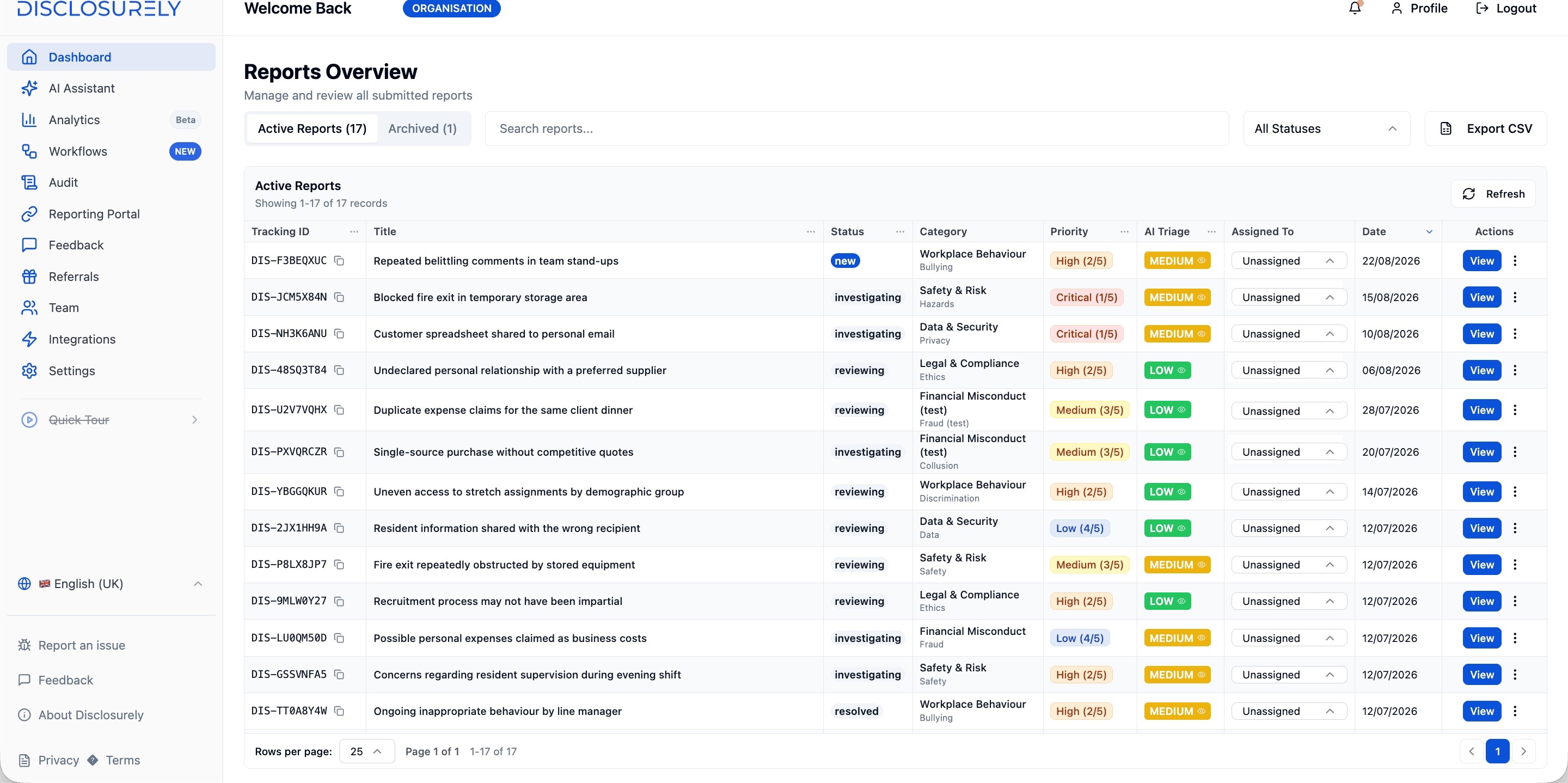
Officer, agency worker, or contractor submits via the secure portal under the council whistleblowing policy
Owner: Reporter
Tracking reference issued; classified as whistleblowing vs grievance vs public/councillor complaint
Owner: Monitoring officer / audit intake
Evidence and clarification gathered via protected two-way messaging—outside political or line email
Owner: Assigned handler
Findings documented with appropriate independence; escalate to auditors or prescribed persons where required
Owner: Internal audit / legal / HR
Outcome logged for chief executive / corporate directors and audit committee scrutiny
Owner: Governance / democratic services
Product fit
A secure reporting channel for local authorities
Disclosurely structures the internal staff whistleblowing route councils must operate under PIDA and employer guidance. It does not replace prescribed-person disclosures, auditor duties, or public complaint systems.

Anonymous portal with secure follow-up
Officers can raise concerns without defaulting to political or line-management email—while investigators use two-way messaging for clarification.
Case management and audit trail
Assign status owners, capture notes and evidence, and retain a documented history monitoring officers and audit committees can rely on.
Authority branding and practical staff access
Custom domain and branding for the staff portal, with a secure reporting link and QR code for civic buildings, depots and intranet communications—distinct from public complaint systems—plus analytics exports for corporate and audit-committee reporting.
FAQ
Whistleblowing FAQs for local government
Questions specific to councils and local authority staff. For anonymity see anonymous reporting, for security see security, and for pricing see pricing.
Give your authority a clear speak-up channel
Set up a branded staff portal distinct from public complaints—with case ownership and an audit trail.