Finance & Regulated Teams
Conduct reporting that meets regulated firm duties
Structured disclosure routes for regulated firms—aligned with FCA expectations, and distinct from complaints and incident systems.

New whistleblowing reports received and assessed by the FCA between 1 April 2024 and 31 March 2025.
Source: FCA Prescribed Persons Annual Report 2024/25 · View source
Times the FCA took direct action against firms based on whistleblower information in 2024/25.
Source: FCA Prescribed Persons Annual Report 2024/25 · View source
Separate allegations contained in FCA whistleblowing reports during the 2024/25 reporting period.
Source: FCA Prescribed Persons Annual Report 2024/25 · View source
What can be reported through your firm’s whistleblowing channel?
Speaking-up in regulated firms sits between conduct risk, financial crime controls, and personal accountability under SMCR. Non-financial misconduct themes—bullying, harassment, and discrimination—must be routed with the same rigour as control and regulatory breaches, and must never be parked in a customer complaints queue.
Disclosures conflated with customer complaints
Staff concerns about conduct, controls, or culture must not be logged in consumer redress systems that lack investigation workflow and audit trail.
FCA prescribed-person route vs internal channel unclear
Workers may not know when to use the FCA’s prescribed-person route versus internal compliance—and internal routes must still produce regulator-ready documentation.
SMCR accountability without case ownership
Senior manager conduct concerns need named investigation owners and controlled visibility—not informal escalation to the SMF holder’s inbox.
Non-financial misconduct (NFMI) under-documented
Bullying, harassment, and discrimination themes need the same case chronology as regulatory breaches—see the FCA’s culture and NFMI survey findings.
Financial crime and control failures
AML, sanctions, fraud, and market integrity concerns require financial-crime ownership without business-line pressure on the case record.
Follow-up pushes reporters into corporate email
Firms still need secure internal follow-up that protects identity when reporters choose anonymity—even when they later engage with the FCA directly.
Process design
How whistleblowing reports are handled in regulated firms
A five-step internal route connecting disclosure intake, compliance ownership, and board-ready records—without mixing whistleblowing into unrelated operational systems.
Worker submits via secure portal or documented hotline route
Owner: Anonymous or identified reporter
Tracking reference issued; category and FCA reportability assessed where applicable
Owner: Compliance intake
Two-way messaging gathers detail and evidence without corporate email
Owner: Assigned investigator
Findings documented with role-based access for compliance, HR, or financial crime
Owner: Named case owner
Outcome logged; themes for audit committee and regulator-ready export
Owner: Company secretariat / board
Product fit
A secure reporting channel for finance and regulated teams
Regulated firms need an internal route they can defend alongside FCA whistleblowing obligations—not a call-centre brochure. Disclosurely structures that internal route; it does not replace regulatory reporting or SMCR accountability.

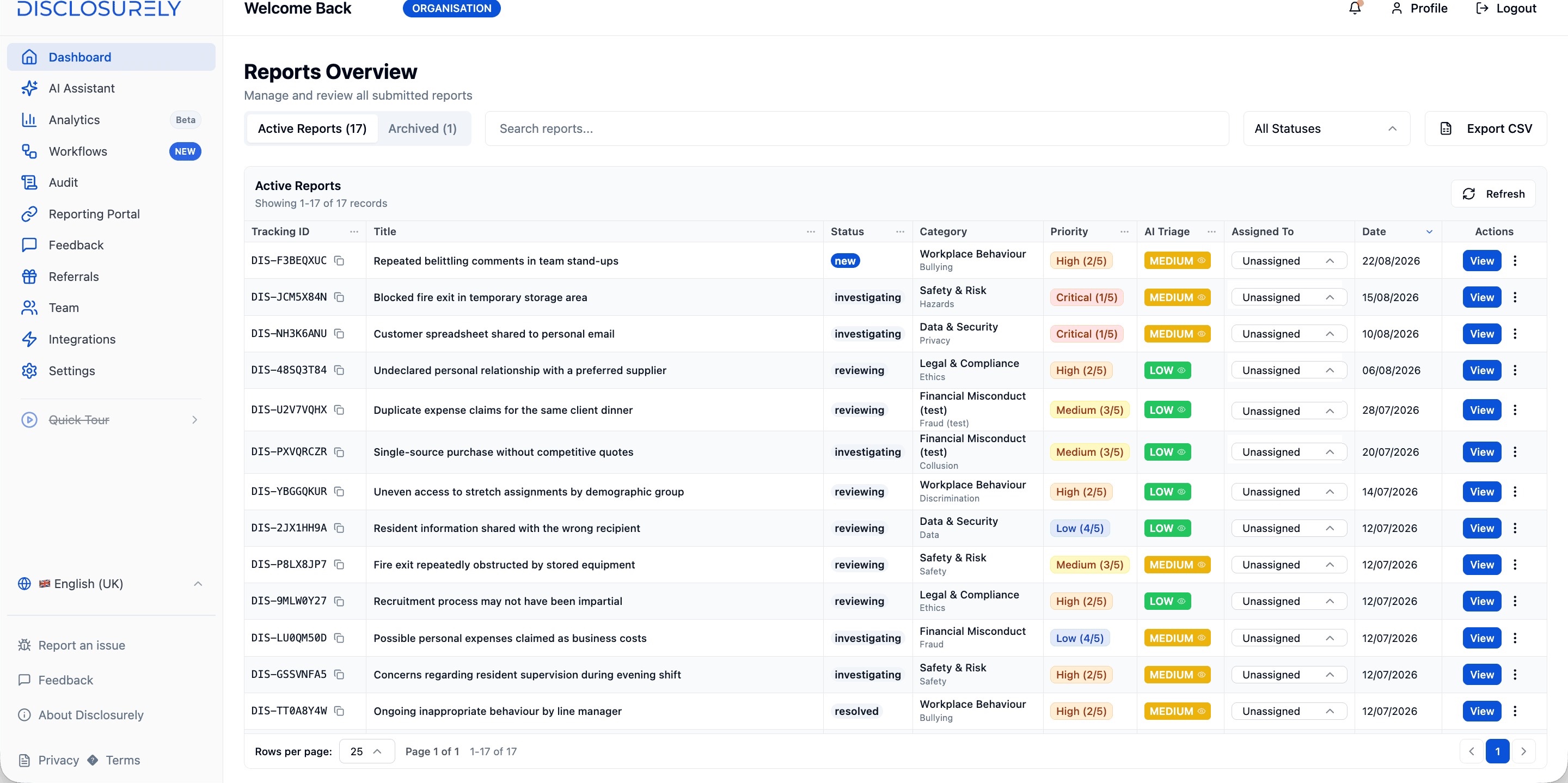
Audit trail for regulatory review
Receipt, ownership, messages, files, and status changes in one case record—supporting internal audit, audit committee packs, and FCA interaction documentation.
Role-based access for NFMI and SMCR cases
Need-to-know visibility for non-financial misconduct and senior manager investigations without circulating details through corporate email.
Kept separate from complaints systems
Configure categories and owners so staff disclosures about conduct and controls stay in a whistleblowing workflow—not a consumer redress queue.
FAQ
Whistleblowing FAQs for regulated firms
Questions specific to regulated firms and SMCR pathways. For anonymity see anonymous reporting, for security see security, and for pricing see pricing.
Give your firm a clear speak-up channel
Set up a branded reporting portal kept separate from customer complaints—with records ready for audit and regulatory review.