Best Anonymous Reporting Tools for Organisations in 2026
We compared Disclosurely, NAVEX EthicsPoint, EQS Integrity Line, SpeakUp, FaceUp, Whistlelink, Whistleblower Software, Safecall and Whispli on anonymous reporting, follow-up, case handling and pricing.
15 July 2026•21 min read•Updated 21 August 2026•Buyer Guides
By Disclosurely Editorial
On this page
Buyer Guides
Best Anonymous Reporting Tools for Organisations in 2026
Teams searching for the best anonymous reporting tools are usually trying to shortlist software, not reread the definition of whistleblowing. The useful question is which whistleblowing platform can take an anonymous report, keep a safe conversation open, and give HR, compliance, or legal a workable case record afterwards.
We compared nine anonymous reporting and whistleblowing platforms on anonymous intake, secure two-way follow-up, case handling, access controls, implementation, pricing transparency, and organisational fit:
Disclosurely is first because it is the strongest fit for SMEs and mid-sized organisations that want a focused reporting workflow and published pricing. It is not the right product for every buyer. A global ethics team may still need NAVEX. A European compliance function may prefer EQS or SpeakUp. A buyer who wants published employee-band pricing will compare Whistlelink and Whistleblower Software. A board that wants trained call handlers may prefer Safecall.
Anonymous reporting tools compared
Comparison of anonymous reporting tools by fit, follow-up, case management, pricing, and deployment
Quoted plans; starting prices based on a 3-year contract
Pricing is shown only where the vendor publishes it. Research date: August 2026.
The table is a starting point, not a scorecard. There are no invented ratings here. The better question is which product matches the way your organisation will actually receive and handle concerns.
1. Disclosurely — Best overall for straightforward anonymous reporting
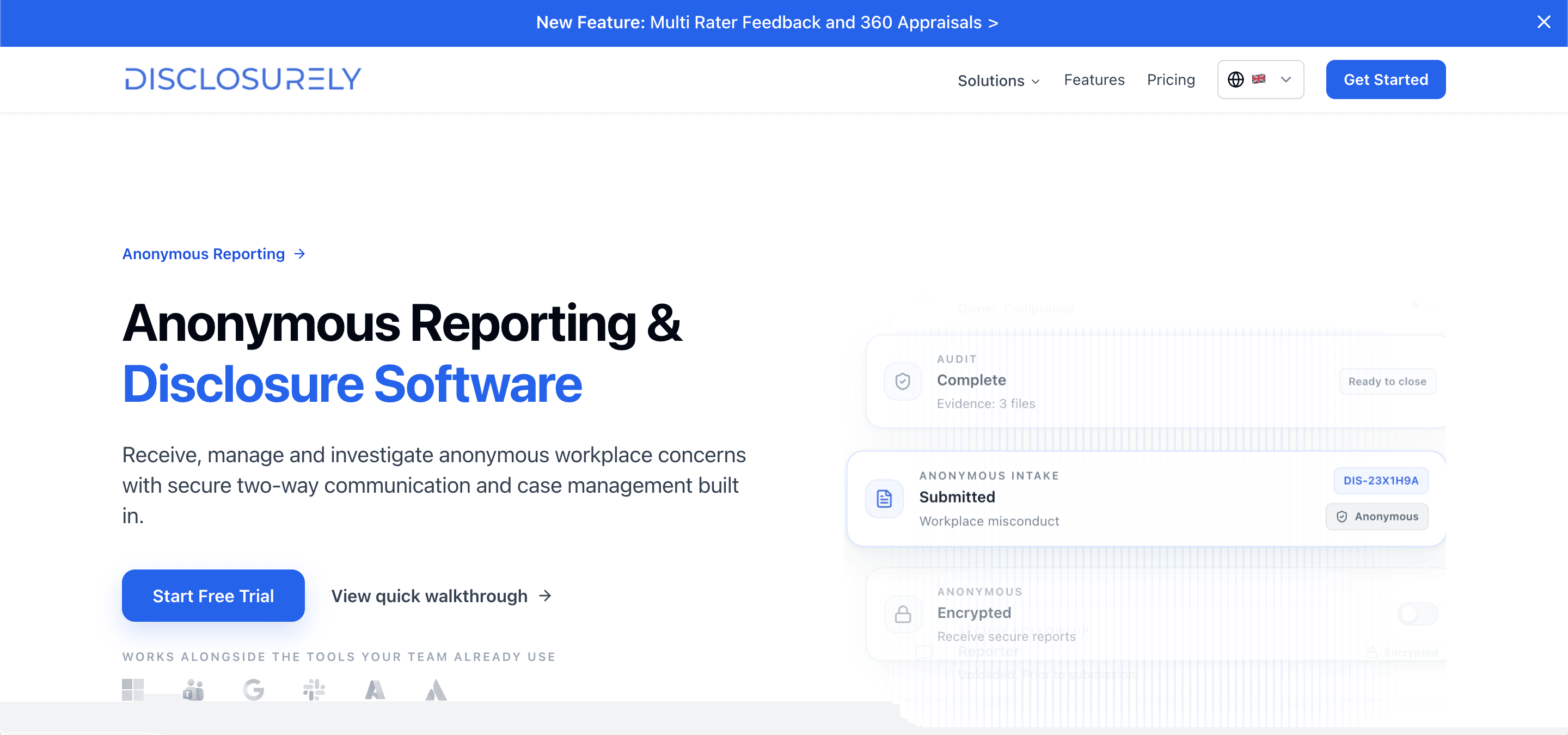
Disclosurely case workspace
Best for
SMEs and mid-sized organisations that want anonymous reporting, secure follow-up, and case handling without an enterprise GRC suite
Pricing
Pro Self-Serve from £39.99/month or £399.90/year; Organisation £149/month or £1,500/year; Enterprise custom
Deployment
Self-serve Pro; Organisation via demo; sales-led Enterprise
Disclosurely is anonymous reporting software built around the operational workflow: a person submits a concern, receives an access code, and can return for secure two-way messaging without creating a reporter account. Handlers then work the case in one place, with assignment, internal handling, file evidence, and a traceable activity history.
That is a narrower proposition than a full ethics and compliance suite. Disclosurely does not try to replace policy management, training, third-party risk, or a staffed telephone hotline. It is designed for organisations that need a credible speak-up channel and a case workspace, without buying a broader GRC ecosystem to get there.
The current public offer is simple. Professional pricing is £39.99 a month, or £399.90 a year. Enterprise is quoted where you need a more involved rollout, dedicated support, or multi-entity handling. The live pricing page also offers a 14-day trial.
What we like
Anonymous submission without a reporter login.
Access codes so reporters can return, ask questions, and send follow-up evidence.
Case assignment, workflows, files, and audit history in the same workspace.
Role-based access rather than a shared inbox.
Reporting portal branding and a custom domain on Professional.
Multilingual reporting in 12 languages.
Published SME pricing instead of a sales-only conversation.
Things to consider
Disclosurely is a younger, more focused product than NAVEX, EQS, or SpeakUp.
It is not a broad ethics, policy, training, or GRC platform.
There is no staffed telephone hotline.
API access, webhooks, and custom integrations are not live yet.
Disclosurely does not currently claim ISO 27001 or SOC 2 certification.
Language coverage is 12 locales, not the 80–170+ ranges some enterprise vendors advertise.
Best fit
Choose Disclosurely if you want anonymous employee reporting software or whistleblowing software with case handling, you do not need a huge integrated ethics stack, and you want to see the price before a demo. If your requirement is a global hotline network or a full GRC suite, start with NAVEX, EQS, SpeakUp, or Safecall instead.
2. NAVEX EthicsPoint — Best for large global organisations
NAVEX EthicsPoint
Best for
Large and global ethics programmes that need hotline, case management, and a broader GRC stack
Pricing
Contact vendor
Deployment
Sales-led, typically with professional services
NAVEX EthicsPoint is the whistleblowing and incident-management product inside NAVEX One. The vendor positions EthicsPoint Professional for enterprise organisations that need to meet multinational reporting requirements and demonstrate programme effectiveness to leadership.
On the official product pages, NAVEX emphasises configurable case management, AI-assisted translation and insights, Power BI dashboards, and reporting through web, phone, and mobile. It also connects speak-up activity to the wider NAVEX ethics and compliance stack, including policy and training where those modules are in use. NAVEX says more than 13,000 organisations worldwide use NAVEX One.
That breadth is the point. EthicsPoint is built for high-volume, multi-country programmes, not for a two-person HR team replacing an email address. NAVEX also offers EthicsPoint Essentials for smaller deployments, but the Professional product is clearly aimed at maturing or enterprise ethics programmes.
NAVEX does not publish a list price for EthicsPoint. Treat budget as a quoted, often annual, enterprise conversation.
What we like
Clear enterprise positioning for global speak-up programmes.
Multiple reporting channels, including telephony.
Case management designed for high volume and regional variation.
Analytics and board-style reporting, including Power BI.
Option to sit inside a wider ethics, policy, and compliance platform.
Things to consider
No public list price on the official pages reviewed.
Implementation is sales-led and typically involves professional services.
The wider NAVEX suite will be more than many SMEs need.
Buyers comparing only anonymous reporting may be paying for a much larger GRC operating model.
Best fit
NAVEX EthicsPoint is the shortlist pick when anonymous reporting is one part of a broader ethics programme, you have a dedicated compliance function, and you need hotline coverage plus enterprise reporting. It is usually the wrong starting point for a mid-sized organisation that only needs a governed reporting channel.
3. EQS Integrity Line — Best for European compliance programmes
EQS Integrity Line
Best for
European compliance teams that want a mature specialist platform, including as part of a wider EQS compliance stack
Pricing
Contact vendor
Deployment
Packaged plans from SME-ready to global operations
EQS Integrity Line is a specialist whistleblowing and case-management platform from EQS Group. The official product materials emphasise anonymous reporting with a dialogue function, integrated case handling, granular authorisation, hosting in Germany, and ISO 27001-certified operations. The reporting interface is available in more than 80 languages, with machine translation available in the system.
Integrity Line is also the speak-up module inside the EQS Compliance Cockpit. That matters if your team already manages, or expects to manage, adjacent compliance work such as policy distribution or third-party risk in the same environment. If you only need a reporting channel, you are still looking at a mature European specialist rather than a lightweight form tool.
EQS publishes plan names rather than current list prices. Essential is aimed at organisations with 50–500 employees, Professional at 500–5,000, and Enterprise at 5,000+. Phone reporting is an add-on on the official plan page, not an assumed default.
What we like
Strong European compliance positioning, including GDPR-oriented handling.
Anonymous inbox with ongoing dialogue.
Case notes, assignment, anonymisation tools, and audit logs.
Broad language coverage and in-system translation.
Clear SME-to-enterprise packaging, even without public amounts.
Things to consider
Current prices are not published on the official pages reviewed.
Some capabilities, including telephony, sit in higher plans or add-ons.
Organisations that do not need the wider EQS compliance platform may find the suite broader than the reporting team asked for.
Implementation support is part of the EQS model; this is not a “buy and ignore” tool.
Best fit
EQS Integrity Line is a strong option for European compliance teams that want a specialist whistleblowing system with mature security and case-handling claims, especially if they may later want adjacent compliance modules. If the requirement is reporting plus gifts, conflicts, and other disclosures in one ethics platform, compare SpeakUp as well. Smaller UK or international SMEs that mainly want published pricing and a focused workflow may find Disclosurely, Whistlelink, or Whistleblower Software easier to evaluate.
4. SpeakUp — Best for scaled ethics and disclosure programmes
SpeakUp
Best for
Mid-to-large organisations that want anonymous reporting plus broader ethics disclosures in one platform
Pricing
Contact vendor
Deployment
Quoted for organisations from 500 employees to global enterprises
SpeakUp is a European ethics and compliance platform. The whistleblowing product is SpeakUp Report: anonymous-first misconduct reporting, with case management included rather than sold as a separate SKU. SpeakUp Paths is a structured disclosure flow for gifts, conflicts of interest, side activities, and similar registers, using the same case engine. Buyers can take Report, Paths, or the combined platform.
The vendor positions the product for organisations from 500 employees to global enterprises, and says more than 750 organisations use it. Official materials emphasise guided intake, anonymous two-way follow-up, structured investigations, and translation or transcription in 75+ languages. SpeakUp also publishes ISO 27001, ISO 27701, and quarterly ISAE 3000 Type II assurance claims. It says the platform does not collect IP addresses, device fingerprints, or identifying metadata.
The pricing page talks about flexible plans, but it does not list amounts. SpeakUp’s own FAQ says pricing is customised by company size and features such as advanced analytics or SSO. Optional Pro add-ons include an AI voice agent, Sienna Insights, extra intake channels, a test environment, and an API. Treat SpeakUp as a quoted mid-market and enterprise conversation, not as a self-serve SME price list. A side-by-side with Disclosurely is on Disclosurely vs SpeakUp.
What we like
Report and Paths share one case-management engine.
Anonymous two-way communication is a first-class part of the product story.
Case management is included with Report and Paths, not an extra module to guess about.
Long-running European vendor with published ISO and ISAE claims.
Aimed at multi-entity, international ethics programmes rather than a single intake form.
Things to consider
No public list price on the official pricing page reviewed.
Official packaging is aimed at 500 employees and above; smaller SMEs may sit outside the intended buyer.
Broader than a focused anonymous reporting tool if you only need a speak-up channel.
AI, extra channels, a sandbox, and API access sit in optional add-ons.
Confirm current language coverage, telephony, and which product (Report, Paths, or both) is in the quote.
Best fit
Choose SpeakUp if you are a mid-to-large organisation that wants anonymous reporting plus broader ethics disclosures in one platform. If you mainly need a focused reporting workflow and a published SME price, start with Disclosurely.
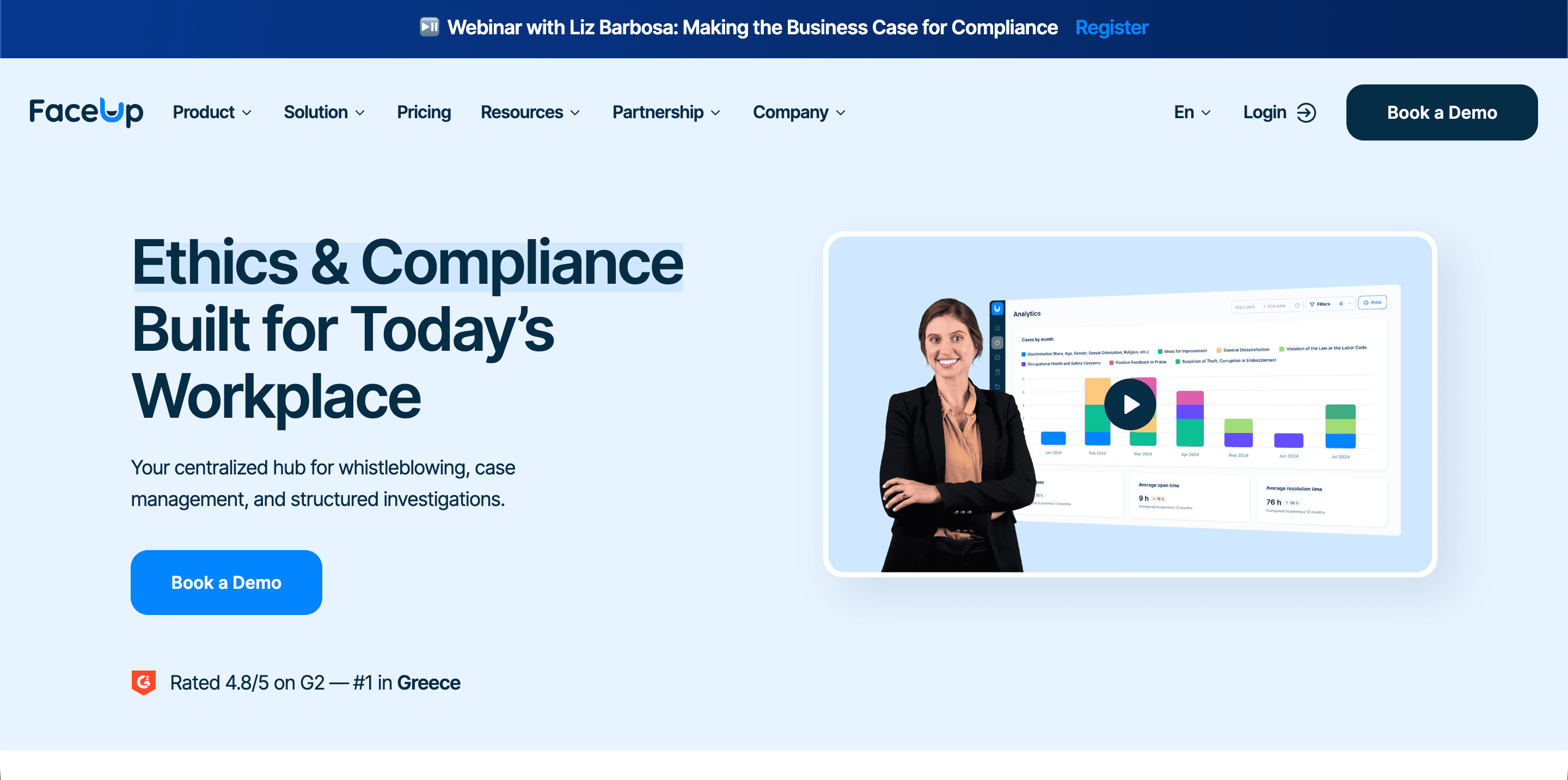
5. FaceUp — Best for flexible reporting programmes
FaceUp
Best for
Organisations that want multiple reporting channels and room to expand beyond a single intake form
Pricing
Contact vendor
Deployment
Self-onboarding; Enterprise onboarding available
FaceUp is an anonymous reporting and case-management platform used for workplace whistleblowing and, separately, school reporting. The vendor says it is used by more than 3,600 organisations in over 70 countries. Official materials emphasise multi-channel intake: web forms, anonymised voice messages, optional phone hotlines, mobile apps, and 113 languages.
The case side is more than a mailbox. FaceUp publishes investigation workflows, internal notes, redaction, assignment, dashboards, and an audit trail. Higher plans add native integrations, SSO, multi-entity setups, and more administrator seats. Starter is limited to one anonymous online form and up to five administrators; Professional and Enterprise open more channels and workflows.
FaceUp’s company pricing page names Starter, Professional, and Enterprise, then asks buyers to get a quote. It does not publish current amounts. The vendor says implementation can be done quickly without IT support; live and AI-powered hotlines are add-ons.
What we like
Flexible intake, including voice reporting and optional hotlines.
Encrypted two-way communication with reporters.
Room to run more than one reporting form or use case.
Security claims that are stated clearly, including ISO 27001 and SOC 2-certified server infrastructure.
Useful if the organisation wants one vendor for workplace and school reporting.
Things to consider
No public list price on the company pricing page.
Starter is a narrower product than the FaceUp homepage suggests; extra channels sit in higher plans or add-ons.
The platform covers a wide range of use cases, so buyers should confirm they are purchasing the workplace whistleblowing configuration they actually need.
Administrator limits on Starter and Professional may matter for larger handling teams.
Best fit
FaceUp suits organisations that want a flexible reporting programme rather than a single intake form, especially if voice reporting, apps, or hotline add-ons are part of the requirement. If you mainly need one anonymous web channel and a case workspace at a published price, Disclosurely, Whistlelink, or Whistleblower Software will be simpler to compare.
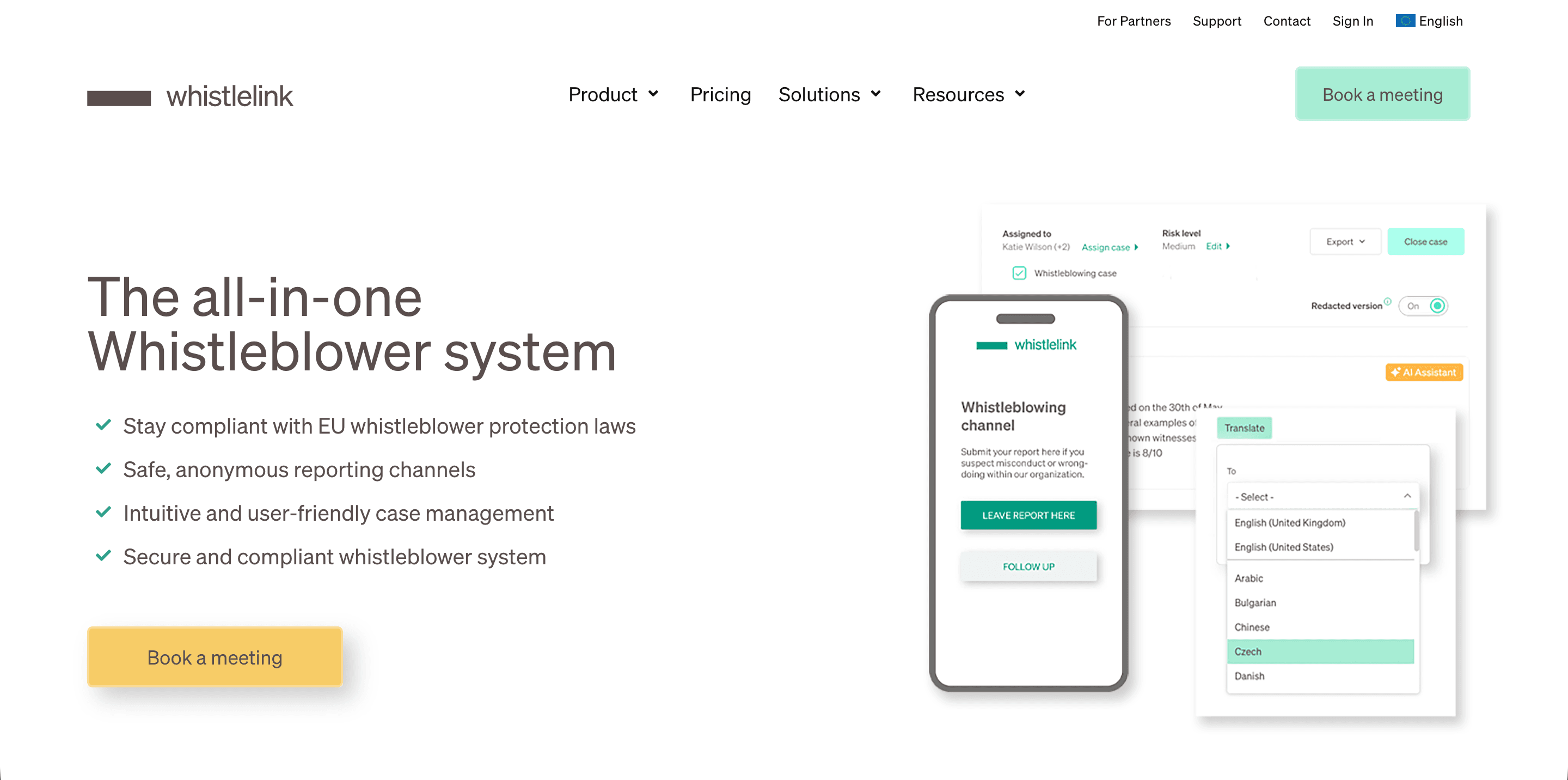
6. Whistlelink — Best for published employee-based pricing
Whistlelink
Best for
Teams that want a complete whistleblowing package with prices listed by employee band
Pricing
From €79/month for 0–49 employees, billed annually
Deployment
Self-service setup; annual subscription
Whistlelink, from Whistleblowing Solutions AB, is an all-in-one whistleblowing system with a reporting site, voice messages, two-way anonymous communication, and case management. The official pricing page is unusually clear by this market’s standards: prices are listed in euros by employee band, billed as an annual subscription.
As of August 2026, the published monthly EUR prices are €79 for 0–49 employees, €99 for 50–149, €149 for 150–249, €199 for 250–499, and €299 for 500–999. Organisations with 1,000 or more employees are asked to get in touch. A 30-day trial is available. Optional add-ons include a live hotline and an intake-management service where Whistlelink acts as first receiver.
The standard subscription is positioned as a complete package: reporting site, case management, multilingual support, and EU hosting. Whistlelink states that it is ISO 27001 certified, does not log whistleblower IP addresses, and hosts data in the EU.
What we like
Actual prices on the vendor’s own pricing page.
Employee-band packaging that finance teams can model.
Written and oral reporting, including voice recording.
Case assignment, internal notes, workflows, and exports.
50+ languages and a 30-day trial.
Things to consider
The commercial model is an annual subscription invoiced up front, even though prices are shown monthly.
Live phone handling is an add-on, not the core software price.
1,000+ employee organisations still need a quote.
Buyers outside the EU should confirm hosting, language, and support fit rather than assume the EU packaging is universal.
Best fit
Whistlelink is the right comparison if transparent employee-based pricing is a procurement requirement and you want one published complete-package table. If you want a Core versus Advanced choice at published employee-band prices, compare Whistleblower Software as well. Disclosurely remains the simpler published-price option if you prefer a flat Professional fee rather than headcount bands.
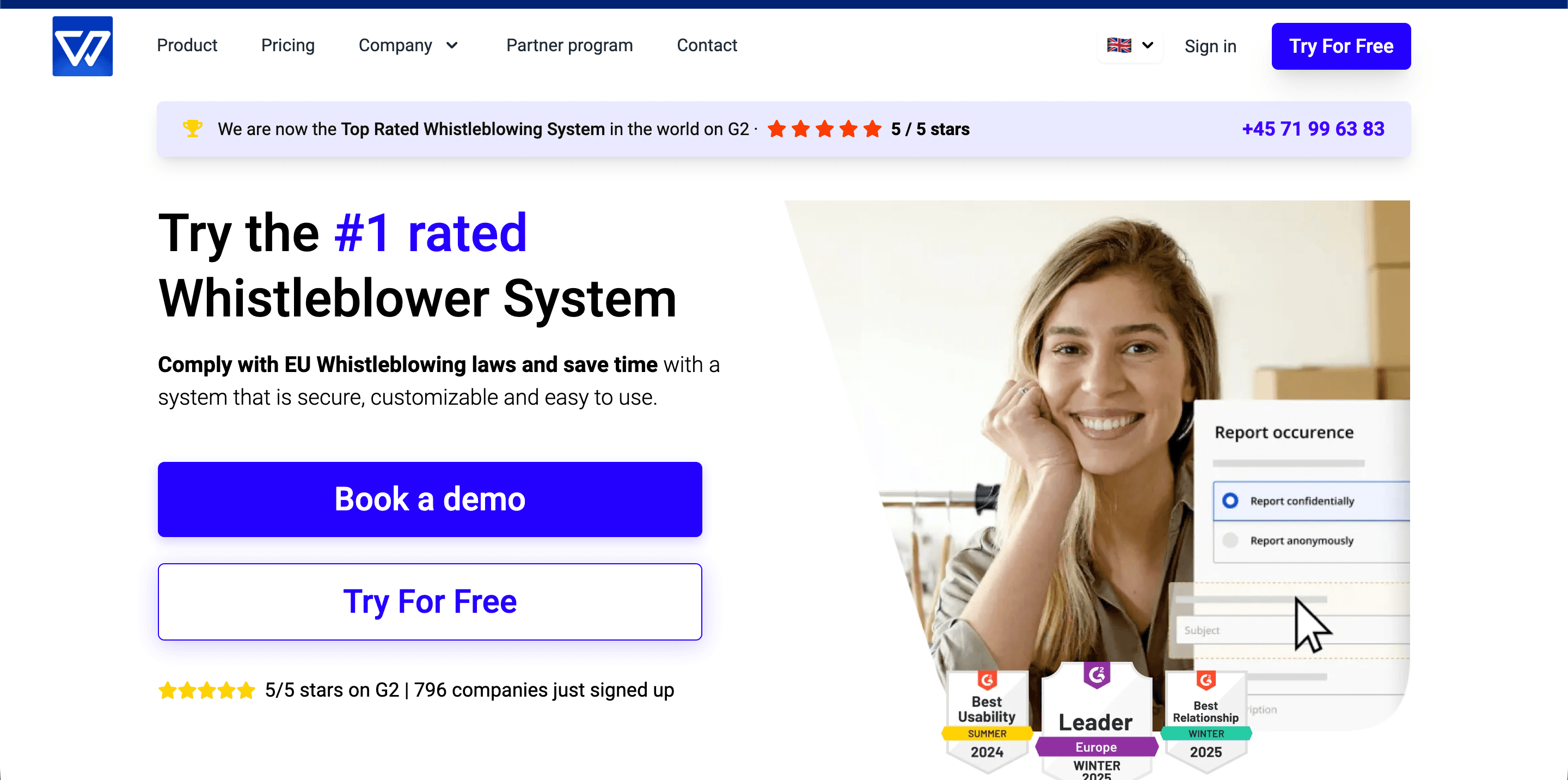
7. Whistleblower Software — Best for published Core and Advanced pricing
Whistleblower Software by Formalize
Best for
EU-oriented teams that want employee-band prices, two-way follow-up, and a Core versus Advanced choice
Pricing
Core from €99/month for 0–49 employees, billed annually
Deployment
Self-serve trial; billed annually
Whistleblower Software, from Formalize, is a European whistleblowing system with anonymous and confidential reporting, a two-way digital postbox, voice reporting, and case management. The official English pricing page is one of the few in this set that lists current amounts: two employee-band tables, shown as monthly EUR prices and billed as an annual subscription.
As of August 2026, Core is €99 for 0–49 employees, €149 for 50–149, €199 for 150–249, €249 for 250–499, and €349 for 500–999. Advanced is €149, €219, €299, €379, and €529 for the same bands. Organisations with 1,000 or more employees are asked to contact sales. A trial is available. The vendor claims end-to-end encrypted communication, ISO 27001 and ISAE 3000 Type 2, unlimited users and cases on the published packaging, and an EU-oriented security posture.
That published split is the buying point. Core and Advanced are not the same product at two discounts; buyers should confirm which channels, security controls, and administration features sit in each table before treating the cheaper band as the quote. A side-by-side with Disclosurely is on Disclosurely vs Whistleblower Software.
What we like
Two published employee-band price tables on the vendor’s own site.
A trial, so the workflow can be checked before an annual invoice.
Two-way postbox follow-up and voice reporting in the public feature list.
Unlimited users and cases on the published packaging.
ISO 27001 and ISAE 3000 Type 2 claims that procurement can ask to verify.
Things to consider
The commercial model is an annual subscription paid in advance, even though prices are shown monthly.
Core versus Advanced needs a feature check, not only a look at the lower band.
1,000+ employee organisations still need a quote.
End-to-end encryption and certification claims should be verified in scope, not copied from a homepage badge.
This is software, not a staffed telephone hotline.
Best fit
Choose Whistleblower Software if you want published Core and Advanced employee-band pricing, two-way follow-up, and an EU-oriented specialist package. If you prefer one complete-package employee-band table, compare Whistlelink. If you prefer a flat Professional fee, start with Disclosurely.
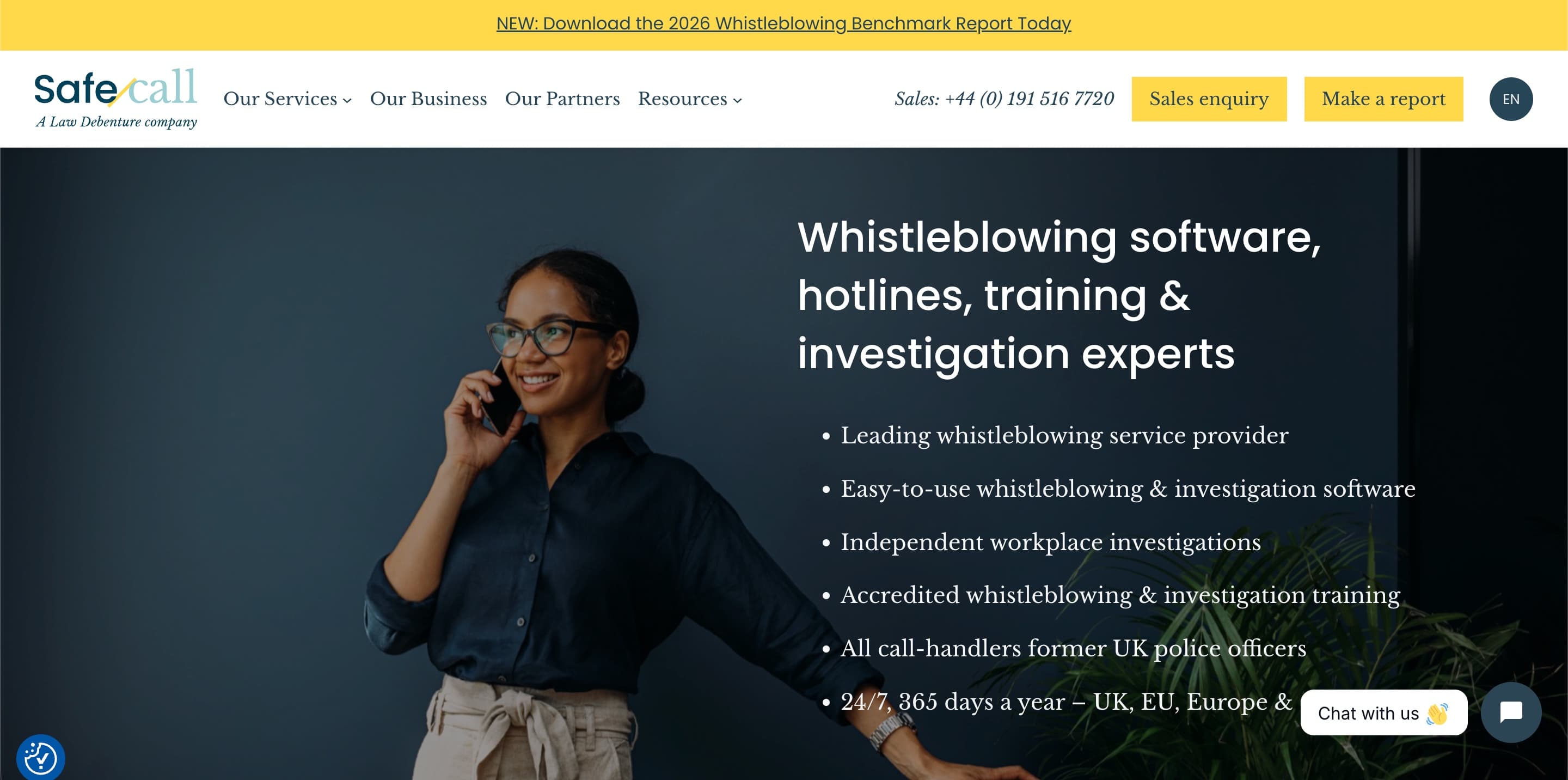
8. Safecall — Best for a managed reporting hotline
Safecall
Best for
Organisations that want trained external call handlers alongside digital reporting and case software
Pricing
Contact vendor
Deployment
Service-led hotline with software onboarding
Safecall is a different shape of vendor. It sells whistleblowing hotlines, online reporting, and case-management software, but the core offer is a managed service: trained call handlers taking reports 24/7, then passing a quality-assured report to the client. Safecall says its handlers have at least 25 years’ experience processing sensitive concerns and that it operates in 175+ languages and dialects.
After intake, the client can use Safecall’s two-way communication channel to continue with the reporter, including where the person stayed anonymous. The product set also includes a custom form builder and investigation case-management software. This is closer to “hotline plus software” than to a self-serve SaaS portal.
Safecall does not publish pricing. Expect a scoped service quote based on workforce size, countries, languages, and whether you want the hotline, the software, or both.
What we like
Genuine managed hotline, not only a web form with a phone add-on.
24/7 availability and very broad language coverage.
Quality assurance before reports reach the client.
Digital reporting and case software alongside the telephone channel.
A good fit where employees are more likely to speak than to type.
Things to consider
No public list price.
You are buying an operating service as well as software, which changes vendor management, SLAs, and cost.
Organisations that only need a web reporting channel may be paying for call-handling capacity they will not use.
Implementation is closer to a service onboarding than to self-serve SaaS.
Best fit
Choose Safecall when the organisation specifically wants an externally managed reporting hotline, usually in addition to digital reporting. If the requirement is a software-only anonymous reporting system, Safecall is a weaker comparison than Disclosurely, Whistlelink, Whistleblower Software, FaceUp, EQS, or SpeakUp.
9. Whispli — Best for anonymous two-way communication
Whispli
Best for
Programmes that put anonymous conversation, flexible intake channels, and case workflows at the centre
Pricing
Contact vendor
Deployment
Quoted plans; starting prices based on a 3-year contract
Whispli is a whistleblowing and case-management platform that puts anonymous conversation at the centre of the product. The vendor describes a Safe Inbox in which reporters are not represented by names or accounts; Whispli says it does not collect IP addresses, device identifiers, or metadata, and that reporters are represented by unique pictograms.
Intake is multi-channel. Official feature materials list web, mobile apps, email, SMS, phone, live chat, and hotline options, with translation support. Case management includes automations, workflows, analytics, and an API. Whispli says it is used by more than 300 organisations and has been deployed in over 60 countries.
Pricing is structured by named plans and handler licences rather than a public employee-band table. Essentials includes up to three licences, Plus up to five, Business up to ten, and Enterprise includes 20 seats plus SSO, SLA, and enhanced security. The pricing page states that published starting prices are for a three-year contract with annualised payment, but it does not show the amounts. Treat every Whispli figure as quote-based.
What we like
Product story and design centred on anonymous two-way communication.
Mobile apps as a first-class reporting route.
Configurable workflows and automations on higher plans.
Choice of hosting region from the Plus plan according to the vendor.
Clear plan names, even without public pound or dollar amounts.
Things to consider
No public list prices; starting figures are quoted against a three-year contract.
Lower plans cap handler licences, which may be tight for shared HR and compliance teams.
The product range is broader than a single anonymous form, so buyers should confirm which channels are in the plan they are being sold.
Do not assume hands-on equivalence with every “anonymous inbox” vendor; compare the actual reporter follow-up flow in a demo.
Best fit
Whispli is the comparison to make when anonymous conversation quality is the main buying criterion and you are willing to work through a quoted, often multi-year commercial. If you want a focused reporting system with a monthly price you can see today, Disclosurely is the more direct evaluation.
Which anonymous reporting tool should you choose?
There is no universal winner. Use the scenario that matches your organisation.
You want straightforward anonymous reporting without enterprise pricing
If two of those statements are true at once, shortlist both and run the same demo script. The product that can show anonymous follow-up, case ownership, and access control in one workflow is usually the one worth keeping.
Anonymous reporting software pricing compared
Pricing models in this market are not interchangeable. Some vendors sell a flat software subscription. Some price by employee count. Some quote a managed hotline. Some fold whistleblowing into a wider GRC contract.
Only three vendors in this set publish current list prices on their own sites: Disclosurely, Whistlelink, and Whistleblower Software. For everyone else, the honest cell is “contact vendor”. Third-party directories and competitor blogs often show estimates; those figures are not used here.
Verified public prices for anonymous reporting software
Tool
Public pricing
Notes
Disclosurely
Professional £39.99/month or £399.90/year
Enterprise contact sales. 14-day trial on the live pricing page.
Billed annually. Advanced starts at €149/month for 0–49 employees. 1,000+ employees need a quote.
NAVEX EthicsPoint
Contact vendor
No public list price on the official product pages reviewed.
EQS Integrity Line
Contact vendor
Plans are named; current amounts are not published.
SpeakUp
Contact vendor
Official pricing is customised by company size and features. SpeakUp says the platform is designed for organisations from 500 employees to global enterprises.
FaceUp
Contact vendor
Starter, Professional, and Enterprise are quote-based.
Safecall
Contact vendor
Hotline and software packages are not list-priced publicly.
Whispli
Contact vendor
Plan names are public; amounts require a quote.
A cheaper tool is not better value if case handling then moves into email and spreadsheets. Compare the number against the workflow included, then read whistleblowing software pricing explained before you treat any quote as expensive or cheap. If you are already in a renewal conversation, are you paying too much for whistleblowing software? is the more useful next page.
What to look for in anonymous reporting software
The vendor pages above answer “which tools?” The checks below answer “how do we compare them without getting lost in feature lists?” This is the same buyer logic as a good anonymous reporting software buyer’s guide, applied after you have a shortlist.
Start with product type
The market still mixes three different products under similar labels.
Lightweight anonymous reporting tools are built for fast setup and simple intake. They can be enough for smaller organisations or an early policy rollout. Limits usually appear after submission: weaker follow-up, thinner permissions, or more manual handling once a report becomes serious.
Whistleblowing and anonymous reporting platforms combine intake with secure follow-up, case ownership, evidence handling, and role-based visibility. That is the strongest fit for most compliance or HR-led programmes.
Broader enterprise governance suites put reporting inside a wider ethics, policy, training, or GRC stack. They can be the right answer for complex environments. They can also mean longer procurement and more software than the reporting team needs.
Anonymous two-way communication
This is the main dividing line. A report often needs clarification, supporting evidence, or a status update. If the platform cannot support safe follow-up, the investigation moves into email and anonymity becomes a slogan.
Look for a reporter access code or equivalent return path, a message history attached to the case, and a way to receive files without forcing the person to identify themselves. Disclosurely’s public explanation of that workflow is in secure anonymous messaging.
Case ownership and workflow
Even if the reporter is anonymous, the handling process should not be vague. Buyers should expect assignment, status, message history, file handling, internal notes, and closure documentation. That is the difference between an anonymous form and employee misconduct investigation software.
Access controls
Sensitive cases should not be broadly visible. The tool should limit access to people who need to review the case, while keeping enough history for later review. For Disclosurely’s current model, see access control.
Evidence handling
Ask how files are attached to the case, who can see them, and whether the record still makes sense if the original reporter never returns. A screenshot in a chat thread is not a case file.
Audit history
You do not need marketing language about “tamper-proof everything”. You do need to see submission, assignment, messages, evidence, and closure in one reviewable history. If a vendor cannot show that in a demo, you are still looking at intake software.
Implementation
Fast setup is useful only if the resulting workflow is usable. Self-serve software, sales-led enterprise platforms, and managed hotlines all have a place. Match the rollout to your team, reporting routes, and governance, not to whichever vendor promised the shortest go-live.
Security and data handling
Buyers need clear answers on hosting, encryption, access control, data handling, and subprocessors. Discount vague superiority claims. For Disclosurely, start with encryption and data handling rather than a slogan.
Disclosurely currently describes encryption in transit and at rest, role-based access, and documented security practices. It does not claim ISO 27001 or SOC 2. Several competitors do make those certification claims on their own sites; verify the current certificate and scope in procurement rather than copying the badge from a homepage.
Pricing
Compare price against workflow depth. A published SME fee, an employee-band subscription, and a managed hotline quote are different commercial objects. If the vendor will not show a price, ask what drives the quote: employees, entities, languages, handlers, telephony, or suite modules.
Questions to ask during a whistleblowing software demo
When the shortlist is down to two or three vendors, stop collecting brochures and make each vendor show the same journey.
How does an anonymous report get submitted on a phone, without creating an account?
How does the reporter come back later without giving an email address?
Can the handler ask a follow-up question and receive a file without learning who the person is?
How is the case assigned, reassigned, and closed?
Where do internal notes live, and who can see them?
What does the audit history include if legal or audit asks for the record in 12 months?
Which roles are excluded from a case that names a senior manager?
What is in the price we were shown, and what is an add-on: extra entity, language, hotline, SSO, extra handlers?
What does implementation look like for an organisation of our size, in weeks rather than in marketing copy?
What evidence can you share on hosting, encryption, access control, and subprocessors?
If the product looks strong at intake and weak everywhere else, you may be buying an anonymous form. That distinction is covered in more depth in anonymous reporting tool versus anonymous form.
How we compared anonymous reporting tools
This comparison is a buyer shortlist, not a laboratory test.
We assessed each product against observable requirements: anonymous intake, two-way anonymous communication, case workflow, access control, evidence handling, organisational fit, implementation model, and pricing transparency. We used publicly available product pages, pricing pages, feature lists, and vendor documentation.
We did not carry out hands-on testing of competitor software. Where a claim comes from a vendor, it is described as something the vendor states. Prices are included only where the vendor published them in August 2026. We did not estimate unpublished fees, invent scores, or treat directory listings as primary sources.
Disclosurely is our product. It is ranked first because it is the best fit for the SME and mid-sized buyer this article is written for, not because it beats NAVEX, EQS, or SpeakUp at enterprise ethics and GRC. If your organisation needs that wider stack, the honest recommendation is to shortlist those vendors.
FAQs
What is the most important feature in an anonymous reporting tool?
For most organisations, it is secure two-way follow-up. Anonymous intake matters, but many real cases need clarification, evidence, and updates after submission.
Should buyers choose a lightweight anonymous tool or a broader case-management platform?
That depends on what happens after intake. If your team needs assignment, investigation notes, evidence handling, and audit-ready records, a broader workflow platform is usually the better fit.
Can one product suit both small businesses and larger organisations?
Sometimes, but not always. Smaller teams often prioritise speed, simplicity, and published pricing, while larger organisations usually need stronger access controls, multi-entity handling, hotlines, or a wider ethics stack.
Do anonymous reporting tools and whistleblowing platforms do the same job?
They overlap, but they are not identical. Some products are focused reporting systems. Others sit inside a broader ethics, compliance, or managed-hotline offering. Compare the workflow you actually need rather than the label on the homepage.
Why do some vendors publish prices and others do not?
Pricing models differ. Some tools charge a flat software fee, some price by employee band, and some quote as part of a wider GRC or managed-service contract. Where a vendor does not publish a list price, treat that as a procurement fact rather than a reason to guess.
Related solutions
Explore the related Disclosurely solution pages for implementation details and workflow context.
Learn what anonymous reporting software is, which features matter most, and how to assess anonymity, follow-up, security, and operational fit before you shortlist vendors.
Learn which features genuinely matter in employee misconduct investigation software and how to compare products without confusing intake tools with investigation workflows.